00 / A field guide to what lies beneath

Read the ground.
See what follows.

A sample becomes a claim. A mine becomes a commitment. The consequences keep moving.

We follow the whole story. Saskatchewan Protocol gives you the depth to question the evidence, understand the machinery, and see what others leave out.

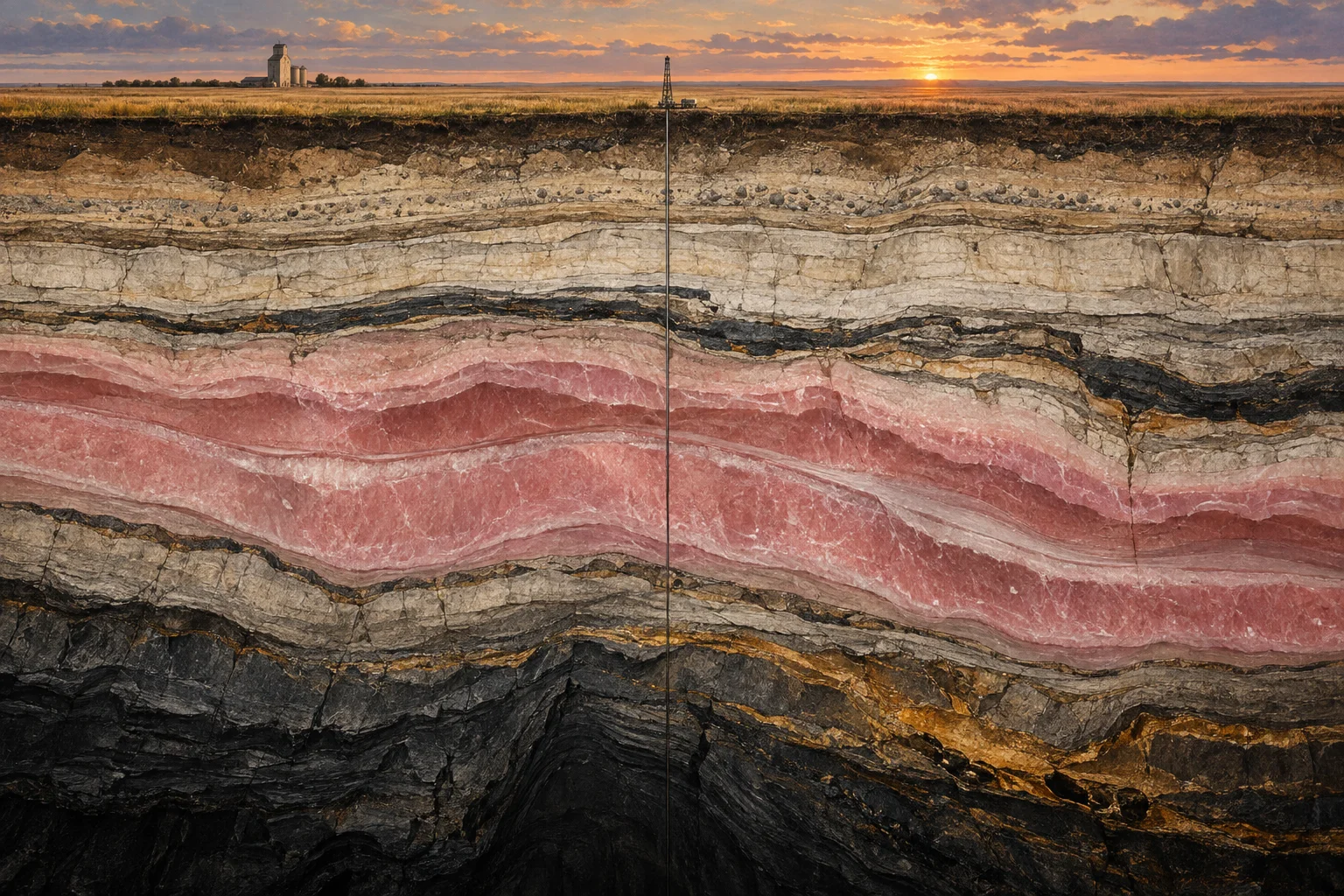
A quiet golden prairie above immense layers of pink salt, pale stone and dark fractured rock, crossed by a slender drill bore.
Fig. 01 — Beneath the familiarConceptual section
Independent writing / Saskatchewan & beyondGeology → knowledge → consequence

01 / Two ways into the ground

Know what holds up.
Follow what happens next.

Resources are a way to understand how we know things—and what we set in motion when we act on that knowledge.

02 /
In an era of claims,
depth is an advantage.

We make difficult systems legible. Our writing connects the material fact to the decision it supports and the consequence it creates. You leave with better questions—and a sharper view of what is at stake.

03 / Take a closer look

The familiar landscape.
Three unfamiliar truths.

Start with our free whitepaper, “3 disquieting things about Saskatchewan.” A resource number is a claim. Water keeps moving. Closure starts before the mine stops.

Get a sharper lens on the province—and the systems that reach beyond it.

Submit your email to open the whitepaper immediately. We’ll store it to record your request. Privacy details.

04 / The reading room

Go deeper.

All 30 articles

A critical-minerals list creates a strategy, not a supply chain

A government can name an element critical in a single publication. This cascade follows that classification into project attention, processing bottlenecks, substitution claims and the difficult work of making material available in a usable form.

A cut-off grade is made from assays but is not an assay

A laboratory result can be precise and still be the wrong number for a mine decision. This article follows sample preparation and QA/QC into block models and cut-off logic, showing where a measurement becomes an economic boundary.

A fault can be a flow path until stress turns it into a barrier

Faults and fabrics organize permeability, repetition and omission in rock, but their role changes with orientation, mineral fill and reactivation. The article uses the Athabasca Basin margin to show why structural interpretation is both necessary and conditional.