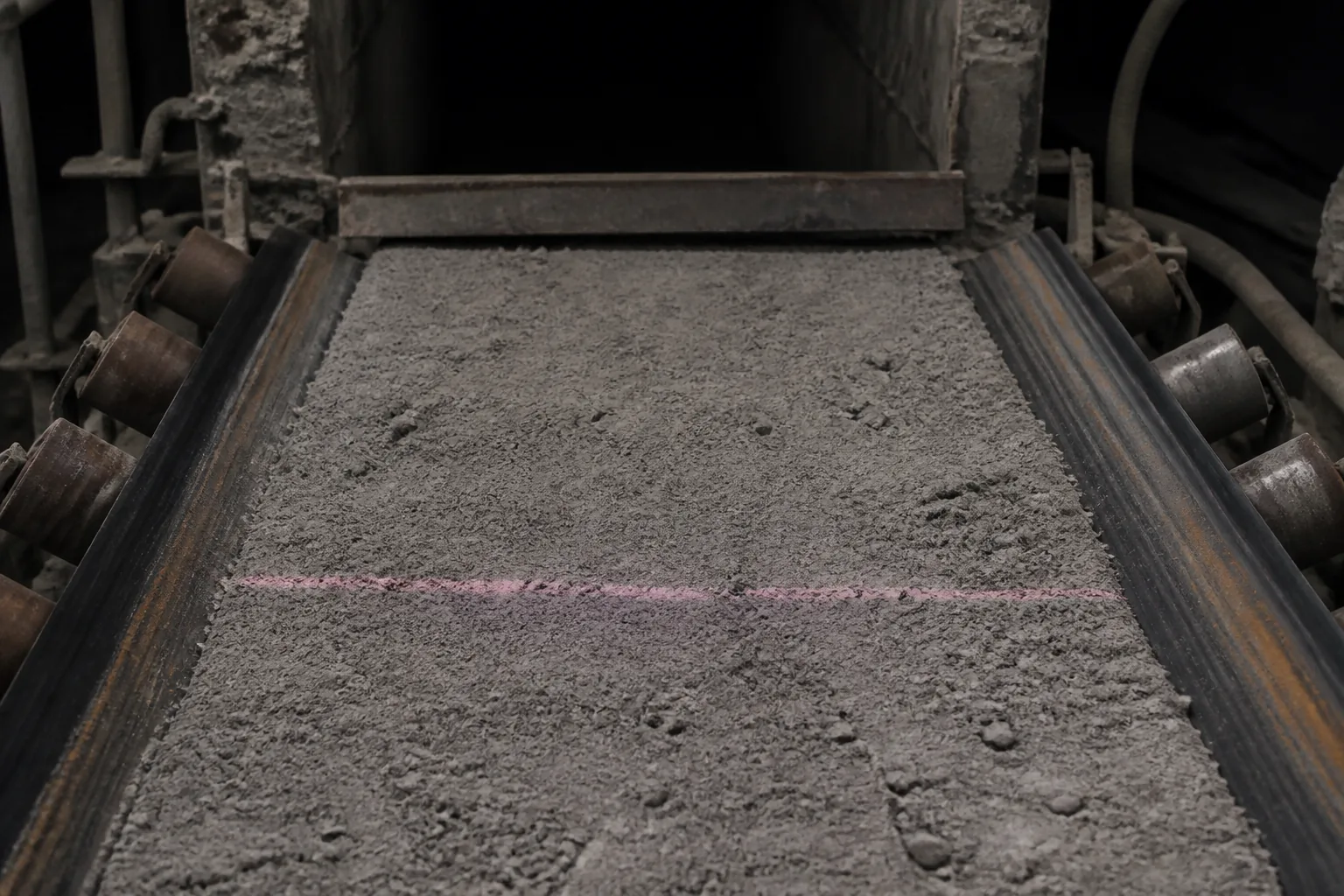
The grey powder is not a rare-earth supply chain.
It may be a mixed concentrate.
It may be a carbonate.
It may be a separated oxide in a labelled drum.
Until its composition, purity, destination and status are known, it is a material at one point in a much longer sequence.
That distinction is physical.
It is not rhetorical.
A government can place a material on a critical-minerals list in a single publication. In the United States process, the designation follows an assessment of disruption across supply chains, then a legal decision by the Secretary of the Interior.
It can alter research priorities, project presentations, permitting attention, public finance, and the vocabulary in which a deposit is described. It can make a prospect legible to institutions that had no category for it.
It cannot make the neighbouring lanthanides stop resembling one another chemically.
At the Saskatchewan Research Council rare-earth processing facility in Saskatoon, that is the local form of a general problem.
A strategic label arrives from policy.
The difficult work begins when a mixed material has to become an acceptable, separately specified product.
The list is a strategy.
The supply chain is the machinery required to make the strategy true.
Criticality is a boundary drawn by an authority
Certain elements are said to be simply critical.
They are not.
Criticality is a policy population.
A named authority judges a particular supply chain important and vulnerable, for a stated economy, technology portfolio or security purpose.
The final United States list of 2025 contains 60 mineral commodities.
USGS provides the technical analysis.
The legal designation is the Secretary’s act.
The list is revised on a stated cycle.
That is not a minor administrative distinction.
The underlying analysis groups mineral commodities into supply chains and models many thousands of disruption scenarios across hundreds of industries. It asks what disruption would do to an economy.
It is not a geological inventory.
It is not a machine that ranks rocks.
The 2025 process makes the seam visible.
The final notice records arsenic, tellurium, metallurgical coal, uranium and phosphate as inclusions following agency recommendations and comments, and boron after further supply-chain information.
Analytical risk measurement ends somewhere.
Accountable policy judgment begins there.
Canada’s list names 34 minerals and metals.
Its screen joins threatened supply chains to a reasonable prospect of Canadian production, then adds economic or national security, the low-carbon and digital transition, or a strategic supply-chain role.
The Canadian test is a different instrument, because it asks a different question. A material can be globally concentrated and fail the domestic-production condition. Another can qualify because Canadian production or processing could matter to a partner supply chain.
The lists overlap.
They do not nest.
The European Union makes the difference more explicit again. Under the Critical Raw Materials Act it identifies a list of critical raw materials, a subset of which are strategic, and attaches benchmarks: at least 10% of consumption from EU extraction, 40% from EU processing, 25% from recycling, and no more than 65% of a relevant processing stage from any one third country.
Those are resilience objectives for a system.
They do not discover criticality in an orebody.
A deposit is a basket
Rare earths are where the gap between a label and a material becomes unusually sharp.
The lanthanide sequence runs from lanthanum to lutetium.
Yttrium is usually included, because its ionic behaviour and mineral associations resemble the heavy lanthanides. Statistics that speak of 17 rare earths normally add scandium.
Those conventions are useful.
They are not a saleable product.
Cerium makes the word rare inconveniently literal.
Its crustal abundance is around 60 parts per million, which places it in the upper quarter of common crustal elements.
Thulium and lutetium are each nearer 0.5 ppm.
A rare-earth deposit is not one scarcity problem distributed evenly across a periodic-table family.
It is a basket.
Praseodymium and neodymium are often marketed together, because both enter neodymium-iron-boron magnet alloy. Their commercial pairing does not erase their separate distributions, prices or product balances.
A project reporting only a total has withheld the part of the chemistry that determines what it can plausibly sell.
The mass basis matters before the story begins.
A composition table expressed as a percentage of total rare-earth oxide does not use ore weight as its denominator. A grade in a carbonatite intrusion is not a universal cut-off, and it is not a magnet composition.
The difference is not bookkeeping.
A sintered magnet is roughly a third rare-earth material by weight, with iron making up most of the remainder and boron a fraction of a per cent. That says nothing about the ore grade that ultimately supplied it.
One number can be correct at the wrong stage.
Mineralogy is what the plant inherits
Hundreds of minerals are known to carry rare earths.
Silicates, oxides, carbonates and fluorocarbonates, phosphates.
That is why rare-earth mineralization is not a processing description.
The useful questions are narrower and harder than a mineral count.
Which minerals carry the values?
At what grain size are they liberated?
Which gangue minerals travel with them?
Are thorium, uranium, niobium, phosphate, iron or fluorine present when measured?
A process does not inherit an element.
It inherits a mineral assemblage, a particle-size distribution and a set of unwanted companions.
Carbonatites have historically supplied light rare earths.
Ion-adsorption clays in southern China are a principal heavy-rare-earth source. The contrast is not a geographic curiosity, and it is not resolved by calling both products part of one statistical population.
A heavy-enriched deposit is not a light-rare-earth deposit with more of everything.
Even the categories carry a warning.
Gadolinium moves between the light and heavy groups depending on the scheme.
Its assignment needs the scheme attached to it.
A group total is derived from chemistry.
It is not chemistry.
The global occurrence record makes the same point at a larger scale. A national database of rare-earth occurrences holds thousands of located records and thousands of references. Location, host rock, alteration, grade, mineralogy and source are all separate fields, because a country name or a total cannot bear the claim people want it to bear.
An element in rock is a starting condition.
Recoverable, marketable material at the intended form is the boundary that matters.
The bottleneck moves and changes its name
The magnet chain has four stages in the Department of Energy account.
Raw-material production.
Processed materials, including oxide separation and metal refining.
Alloy and magnet manufacture.
Use in end products.
A mine can satisfy the first stage and leave the strategic problem nearly untouched.
The DOE chain estimate assigns China 58% of rare-earth mining, 89% of separation, 90% of metal refining and 92% of sintered magnet manufacture.
The figures are stage-specific and date-specific.
Their meaning is not that the mine share is unimportant. It is that the mine share cannot stand in for every stage after it.
This is why a press release can be accurate and misleading at the same time.
A facility may be announced to separate concentrate.
It may be operating a pilot.
It may produce a mixed material.
None of those propositions establishes production of separated praseodymium-neodymium, metal, master alloy or a qualified magnet. Actual output, nameplate capacity, announced capacity and a project target are different kinds of fact.
The product form carries the consequence.
A mixed concentrate, a separated oxide, a fluoride, a carbonate, a metal, a master alloy, magnet scrap and a finished magnet are not interchangeable masses. They need different plants, different input specifications and different trade classifications.
A table that blends them can manufacture diversification on paper.
Saskatoon matters here because an institution concerned with rare-earth processing is not simply adjacent to a mine story.
Processing is where the category confronts the chemistry.
The current facility claims, what material enters and leaves, at what status and what scale, need primary-source verification before they can stand as supply facts.
The mine is not the whole problem.
Sometimes it is not the limiting problem.
Performance is a second separation
Not every rare earth is wanted for the same reason. Neodymium-iron-boron magnets are valued where volume and mass are constrained.
A separated element still has to enter a product whose performance a customer can use.
Terbium and dysprosium show why a basket cannot be reduced to a magnet slogan. They are high-temperature performance additions, not the bulk rare-earth mass of the magnet.
In the DOE comparison, a standard N52 grade carries a recommended maximum operating temperature of 80 °C and less than 0.5 wt.% dysprosium. An N42SH is listed at 150 °C and about 4.2 wt.% dysprosium.
That contrast is a design fact.
It is not a promise that every motor contains a fixed percentage of dysprosium.
Grade, manufacturing route and grain-boundary practice all matter.
The customer’s specification is another bottleneck.
It can be more exacting than the public label that directed attention to the deposit.
This is also where substitution belongs.
The European methodology considers the technical and cost performance of substitutes, and substitution and recycling reduce its supply-risk score.
That does not mean a substitute appears whenever a material becomes expensive or politically inconvenient. It has to perform the required job, at an acceptable cost, in a specific design.
Substitution changes the route through the system.
It does not abolish the system.
Secondary material arrives late
Recycling is narrated as the shortcut around the mine and the separation plant.
It is neither.
The IEA reports end-of-life permanent-magnet collection below 15%, and says most current rare-earth recycling feedstock comes from manufacturing losses.
The distinction is temporal.
A future stock of magnets is not present feedstock.
A collected magnet is not sorted feedstock.
Sorted feedstock is not recovered material.
Recovered material is not necessarily qualified for its original high-purity use.
The IEA finds that secondary rare-earth supply could triple by mid-century under its pledges scenario.
The conditional language matters.
The route depends on collection, dismantling, sorting, recovery yield, economics and product purity.
It can reduce a future vulnerability without making a present processing bottleneck disappear.
The same restraint applies to mine waste.
Tailings and slags may hold values.
Until characterization, permissions, processing, liability and economics are resolved, they are not present-day reserves.
Counted metal is not available material.
This is not an argument against recycling, reprocessing or substitution. It is an argument for naming the intervening work.
A list changes attention first
The cascade begins with a decision that is real and bounded.
A jurisdiction publishes a list.
Research agendas gain a category.
Explorers frame a project against a stated policy purpose.
Processing proposals acquire a strategic rationale.
Governments set diversification benchmarks.
Then the physical system answers back.
Mineralogy determines what enters the circuit.
Separations determine whether the mixture becomes elements.
Refining determines whether an oxide becomes a metal.
Manufacturing determines whether the metal becomes an alloy or a magnet. Specification determines whether the product can enter an application. Substitution, recycling, competing supply and customer qualification determine whether the new route holds.
The first-order effect is easy to describe.
An element becomes critical in a named policy system.
The rest of it is material.
What we do not know is the sequence
The available record can say that rare-earth elements occur together while requiring different products. It can say that mineral carrier, product form and stage-specific capacity matter. It can show why a list is a time-bound decision rather than a geological verdict.
It cannot decide which particular separation sequence will prove economic at scale for a particular project. It cannot identify in advance which customers will qualify a product, which competing supplies will arrive first, or which substitution will become technically and commercially acceptable.
Those are not missing adjectives in a strategy document.
They are the work that turns a strategy into a supply.