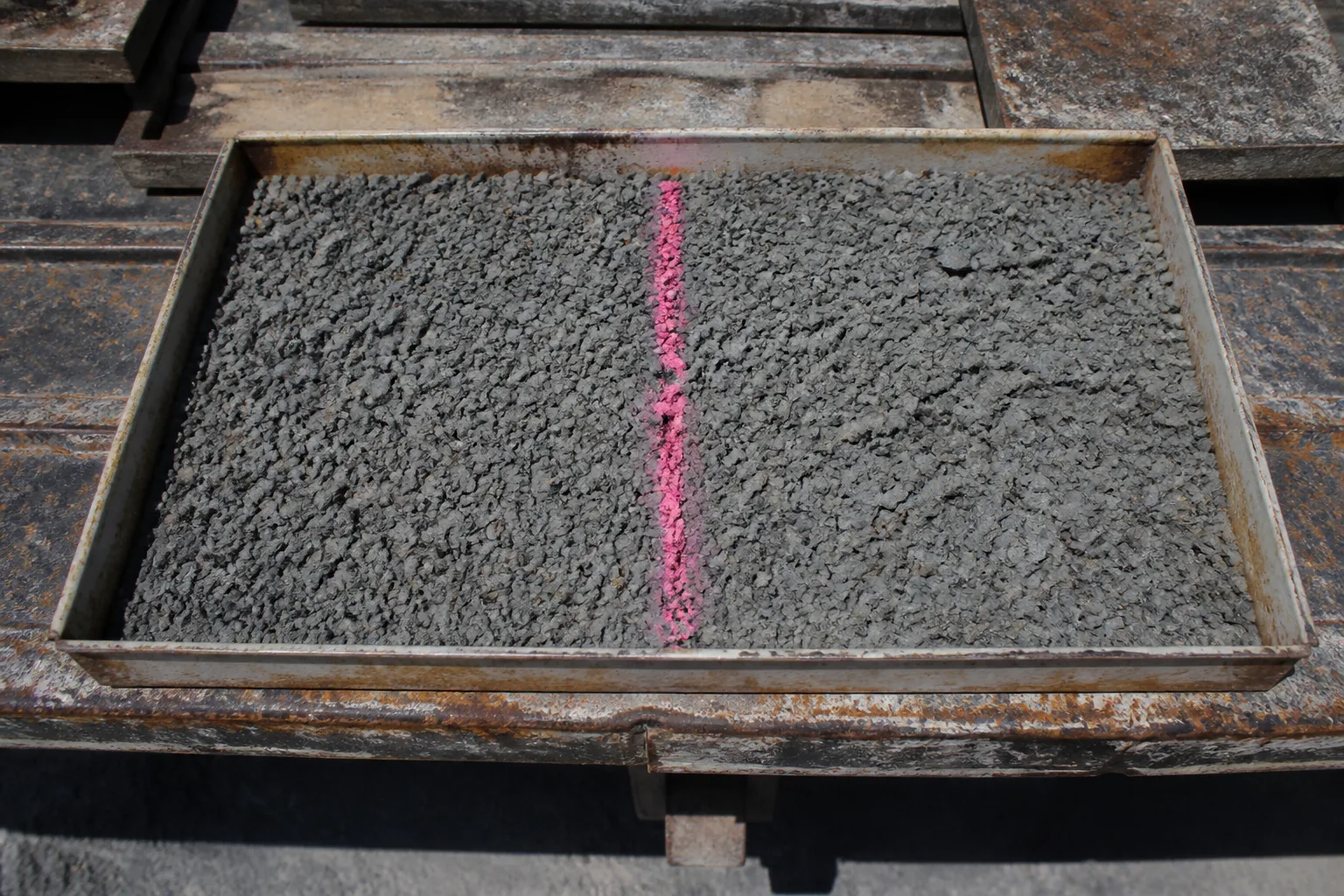
A grey pulp can be required to pass an aperture of 75 µm before the laboratory weighs any of it.
Not metaphorically.
Not as a claim that the rock has been reduced to its essential truth.
It is a preparation state. A stated fraction of a crushed and pulverised sample, small enough to pass a particular screen. In one routine route, 85% has to pass that aperture.
The same route crushes coarser material first, retains a split for pulverising, and preserves the reject and the pulp for later work.
That is already a great deal of decision-making before analysis begins.
Assaying is imagined as a number on a certificate. A value in parts per million or grams per tonne appears to settle a question that was formerly trapped in rock.
It does not.
The assay says something exact about a prepared portion, by a named method, under a chain of controls. The mine needs to know what is likely to exist between and around those portions. How much material can be selected. What it costs to move and treat.
What it recovers.
Which destination displaces another.
The number is real.
It is not yet a cut-off grade.
A pulp is a prepared state
Crushing and pulverising reduce a physical problem before they create a chemical one. The whole sample is dried where necessary, crushed, split, pulverised, screened, then sampled again for an analytical charge.
The order matters.
Crushing before splitting makes the population more manageable. Pulverising before a small charge makes the charge less hostage to one grain.
The result called 85% passing 75 µm does not say that every particle is that size or smaller. It says a measured proportion of test pulp passed the aperture.
It tests fineness.
By itself it does not test recovery, assay accuracy, or whether the original material was represented by the sample in the bag.
This is why the laboratory record needs masses, retained rejects, sieve checks and cleanliness controls as well as a reported concentration. A preparation blank or barren wash put through crushing can inspect carryover from reduction equipment. A chemical blank inserted only after pulverising cannot do that job.
Control location is part of the measurement.
The exception makes the rule clearer. A coarse-gold route retains a larger mass and crushes less finely, rather than treating all material as routine pulp. When visible gold, erratic duplicate pairs or geological evidence point to coarse particles, a laboratory can screen whole prepared material, assay the coarse fraction, assay the fine material, and calculate a mass-weighted total.
The coarse fraction may carry an extraordinary grade. Its contribution still depends on its mass.
That is not a technicality. It is the problem of support: which volume, mass and particle population a number actually represents.
A certificate has conditions attached
For solid geological material, 1 ppm by mass equals 1 g/t. The conversion is useful because it catches unit mistakes. It does not turn unlike measurements into the same measurement.
A reported value of “less than” a stated threshold is not zero. It is an upper censoring limit. A result above a reporting range needs its overlimit determination, not the first number that exceeded the range.
Method is equally material.
A 30 g fire assay and a partial-leach indication can each produce a gold number. They do not share the same analytical portion, chemistry or reporting meaning. Multi-element work uses its own digestion and portion mass, and a four-acid digestion does not mean an instrument certificate has four analytes.
Fire assay itself needs its collection and finish recorded. Atomic-absorption, plasma and gravimetric finishes answer the words fire assay differently.
This is not pedantry about laboratory paperwork. A certificate without sample identity, analyte, unit, method code, lower and upper reporting limits, censoring status, and dilution or special finish is an incomplete measurement.
At the Cigar Lake and McClean Lake uranium operation in northern Saskatchewan, the same distinction travels from a certificate to a mine decision. The operational question is not whether a laboratory can produce a uranium concentration.
It is whether concentrations measured at particular supports, and qualified in particular ways, can bear the interpolation, material routing and economic boundary imposed on them.
No certificate can answer that alone.
Controls locate different errors
Quality control can make different tests sound interchangeable.
They are not.
A certified reference material compares a measured result with an assigned value and its certificate uncertainty. It is evidence about accuracy. A project may place a low-grade reference near the values that decide a threshold and a high-grade reference near ore-grade values, because neither tests the other range.
A blank asks a different question. Did material or signal appear where it should not? A project coarse blank inserted under a new number tests farther upstream than a laboratory preparation blank. Its position after a high-grade sample can matter as much as its numerical value.
A duplicate asks about precision, and only at the stage where duplication began. A pulp duplicate measures repeatability after pulverising. A coarse-reject duplicate includes crushing and splitting. A field duplicate includes collection and the earliest handling. The project still has to state whether pairs are blind, independently prepared, and representative of the grade population.
An umpire comparison is another branch again. Pulp-to-pulp checks emphasize finishing and pulp handling. Reject-to-reject checks admit more sample-reduction variation.
Sending only spectacular results to a second laboratory tests a preference, not an agreement.
The controls do not certify certainty.
They locate uncertainty.
The model outgrows the assay
An assay interval is observed material after preparation. A block is a numerical object made to represent unobserved material over a larger support.
Economic geology decides which observations may be averaged together. Lithology, structure, alteration, weathering, mineralogy and grade continuity can define estimation domains, because material that looks similar in a table may have different continuity or recovery. The resulting block model carries grade, density, geological code, confidence class, and later mining and processing attributes.
Consider a block ten metres on a side. It contains a thousand cubic metres. It does not contain a thousand tonnes.
Tonnage follows only after density is applied. The grade is an estimate averaged over the block support. It is not an assay waiting at the centre for someone to find it.
The distinction becomes operational the moment mining starts. A block model needs validation against nearby data at several scales, swath plots, sensitivity to domains and search direction, and eventually grade-control and plant reconciliation.
If recovery varies by mineralogy, a single head-grade field is not enough for routing. If a faulted block changes dilution or access, an attractive concentration can be the wrong decision number.
Interpolation is therefore an inverse problem. It begins with sparse measurements and asks what distribution between them could have produced them. Several distributions can agree with the same set of samples. Domaining, search directions, density assignments and continuity assumptions constrain the answer.
None of them removes the fact that the answer is estimated.
The model does not discover a hidden assay.
It makes a managed claim about volume.
A cut-off chooses among futures
Once blocks exist, grade joins other variables. A block can become waste, leach feed, mill feed, stockpile feed, blend material or a separate process stream. Mining cost, process cost, recovery, capacity, slope or development sequence, material characteristics, price, and the opportunity cost of plant capacity decide among them.
That is why cut-off is usually a destination policy rather than a permanent black line between ore and waste. Plant capacity makes a tonne valuable relative to the tonnes it prevents from being treated.
A published New Carolin comparison makes the dependence stark. At a 2.0 g/t gold cut-off, the inventory reported 2.589 million inferred tonnes at 3.34 g/t. At a 0.5 g/t open-pit cut-off, it reported 12.132 million inferred tonnes at 1.53 g/t.
The threshold moved.
Tonnes, grade and geometry moved with it.
So did time.
If a mill is capacity-limited, early processing of marginal material can delay higher-margin feed and lower net present value, even where the marginal material is positive at an undiscounted break-even cut-off. A low-grade stockpile can instead smooth feed or extend an operation.
The boundary is a schedule result as well as a block result.
The assay supplies a necessary input. It cannot select the future.
What don’t we know?
The difficult uncertainty is not whether laboratory controls are useful.
They are.
Nor is it whether a block model can organize observations for a mine plan.
It has to.
The difficult uncertainty is whether the supports connect honestly.
Does the sample mass capture the local variability that matters? Does the crush, split and pulp preserve it? Are coarse particles adequately represented, or has a rare grain made a routine charge look more certain than it is? Do duplicate results show analytical scatter, reduction variance, or geological heterogeneity? Does the estimation domain respect a real boundary, or only a convenient one?
The questions intensify at Cigar Lake and McClean Lake, because the destination consequence is much larger than any individual certificate. The site supplies a Saskatchewan address for a general problem. A measured concentration has to survive changes in physical support, spatial interpolation and economic use before it becomes a planning boundary.
That survival is never automatic.
An assay can be accurate. A reference material can sit within its bands. A blank can be clean.
A duplicate can agree.
A block model can validate acceptably against the data available.
And the material between samples can still be more variable than the decision permits.
This is not an argument against assays, or models, or cut-offs. It is an argument against asking any one of them to do another’s work.
The boundary is made, not found
The laboratory begins with matter. Bags, tags, mass, fragments, pulp, reagents, charges and response. It makes a concentration measurement and preserves the conditions under which that measurement may be trusted.
The mine begins with a different problem. It has to turn estimates into blocks, blocks into destinations, destinations into a sequence, and a sequence into recovered and payable material.
A resource can be well drilled and still have no reserve, if mining, processing, infrastructure or other modifying factors do not support a justified operating case. CIM recognizes an Indicated-to-Probable and a Measured-to-Proven relationship, and no direct Indicated-to-Proven route.
The distinction is severe because it prevents a familiar error. A high-grade certificate does not contain a mine. A low-grade certificate does not contain waste. Neither carries the cost, recovery, capacity, schedule, dilution, access or alternative use of a mill hour.
Those things are added later.
They have to be added later.
A cut-off grade is made from assays. It is also made from the ways assays fail to represent larger material, from density and geometry, from recovery and capacity, from the order in which a mine can act, and from the alternatives each tonne excludes.
It is a boundary between possible futures.
That is why it cannot be found in a vial.