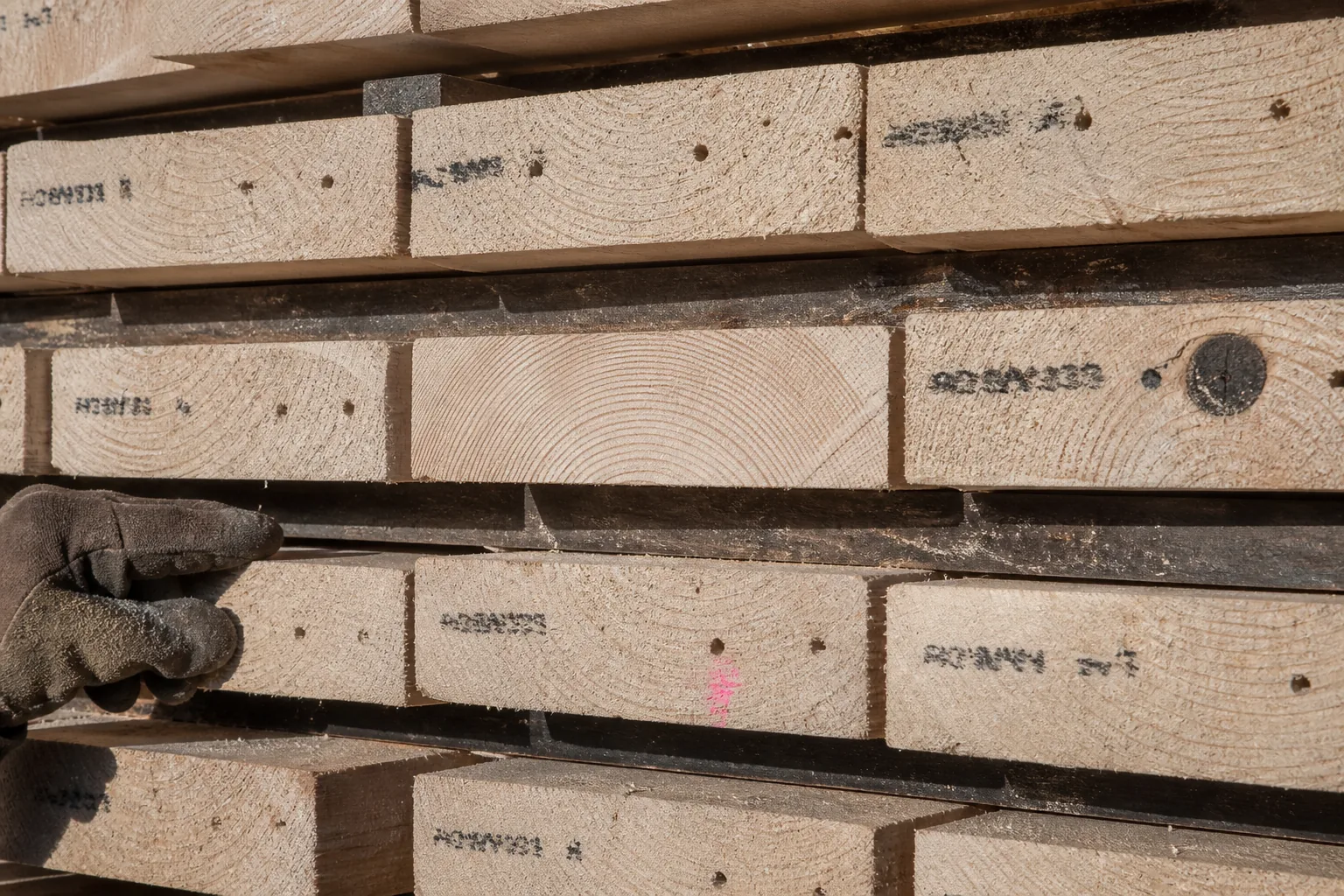
At a freshly cut end of a board, the annual rings are still there.
Not as decoration.
Not as an origin story kept for a furniture catalogue.
The rings are geometry.
Their direction tells the board which way it will change when its moisture changes, where it will bear well, where it can split, and which dimensions a designer has to let move.
The saw has separated the board from the tree.
It has not separated the board from the tree’s structure.
In the Prince Albert boreal supply region, that distinction begins in the log yard. It persists through lumber, panels, beams, floors, pallets and paper, and through failures that arrive much later as a gap, a cup, a crushed bearing surface or a softened connection.
A piece of wood is assumed to become a product when it is sawn, dried and stamped.
It does not.
It becomes a product when a manufacturing system decides which parts of its biological variability can be measured, sorted, oriented, accommodated and recorded.
And which parts stay as uncertainty in service.
Everything after that is design.
The board keeps the tree’s coordinates
Wood has three material directions.
Longitudinal follows the trunk and its fibres.
Radial runs from the pith outward across the rings.
Tangential follows the rings around the trunk.
Those directions are not names for one behaviour.
Along grain, axial fibres carry tension and bending efficiently. Across grain, tension is comparatively vulnerable to splitting and separation. Compression parallel to grain crushes or buckles elongated cell structures. Compression perpendicular to grain is a local bearing or cell-collapse problem.
Shear follows another set of planes again.
This is anisotropy.
One substance, several mechanical worlds.
A tension test result is not wood strength.
It is a result for a particular load path, direction, specimen and protocol.
A beam on edge can be adequate in bending and in shear parallel to grain while its support is controlled by compression perpendicular to grain. A fastener group can turn a broadly longitudinal load into a local splitting force across grain. A notch near a support disturbs a high-shear region. A bearing plate changes the local compression problem by spreading it.
The board is not inconsistent.
The question has changed direction.
Moisture makes the geometry visible
Below the fibre saturation point, a change in air condition changes equilibrium moisture content.
The cell walls gain or lose bound water.
The wood swells or shrinks.
It does not do so equally.
Tangential movement generally exceeds radial movement.
Longitudinal movement is much smaller than either.
A long board can keep its length and change materially in width.
The cut of the board decides how those unequal movements appear.
As cupping.
As width change.
As checking.
As joint stress.
A published preliminary rule gives roughly 1% radial or tangential dimensional change for each 4% change in moisture content. The implication is plain enough in practice: a 300 mm width exposed to a 4-point transverse moisture change can imply about 3 mm of movement, before species and cut refine the estimate.
That movement is not a defect report.
It is the material doing what its anatomy requires.
The design consequence is not to demand stillness.
It is to decide where a part is fixed and where it may slide.
Which holes are elongated.
Which gaps absorb width change.
Whether a frame will restrain a panel at mutually conflicting points.
A wide solid panel needs a movement detail.
A long narrow member can be fixed at one point and allowed to slide elsewhere.
Finishes do not repeal this.
The Forest Products Laboratory says coatings retard moisture-driven change and do not prevent it.
A coating changes time.
It does not abolish equilibrium.
This is why moisture content at fabrication, and the anticipated service condition, belong to the product decision. A close-tolerance component dried and conditioned for one environment can arrive in another with its own later adjustment already built into it.
Density is a condition first
The next temptation is to let density settle the argument. Dense wood is often harder, and within a comparable population and condition it tends to accompany many higher strength measures.
That correlation is useful.
It is also easy to misuse.
Density is mass and volume at a stated condition.
Water changes both.
A Forest Products Laboratory example converts a basic specific gravity of 0.55 to 678 kg/m³ at 12% moisture content. The figure with its condition attached can be compared.
The bare number cannot.
It leaves open whether it describes green wood, oven-dry wood, another moisture condition, or another convention for specific gravity.
The reference state is not paperwork attached after the measurement.
It is part of the measurement.
Even a properly stated density cannot promise the behaviour of a particular board.
A knot interrupts fibres.
Diagonal grain changes the load path.
A check reduces continuity.
Juvenile or reaction wood alters response.
Moisture can still govern the result.
Decay can control a member whose average density is perfectly ordinary.
Fungal attack makes this severe.
Laboratory work finds substantial toughness losses by the time wood has lost a single per cent of its weight, and most strength measures falling by more than half at a tenth.
The outside of a board can look less consequential than the process inside it.
Density is a predictor.
It is not an alibi.
A species name is not a board
Species matters, because anatomy, heartwood, sapwood, working behaviour and durability are biological facts. The opposite error is easy: treating the species name as a complete material certificate.
It is not.
Douglas-fir is neither a true fir nor a spruce. Western larch has similar properties and is sometimes sold mixed with it. Southern Pine is a commercial grouping that can include longleaf, slash, shortleaf and loblolly. SPF is a commodity grouping under regional grading practice, not a botanical species, and not a statement of what an individual board contains.
The named tree, the commercial group and the board in hand are different scales of identity.
Western redcedar makes the point from another direction.
Its heartwood is very decay resistant.
Its nearly white sapwood band is often narrow.
The distinction is not ornamental.
A claim about durable heartwood cannot silently migrate onto a board face containing sapwood, then onward into a promise about ground contact, coating life, fasteners or drainage.
Biological resistance is always conditional.
Wood zone, exposure, treatment status and service condition have to travel with the claim.
The same insistence applies to identification.
A useful species record begins with the accepted scientific name, the standard common name, and the trade name actually used on the material.
Three names before a property claim.
A species handbook can support a starting expectation.
It cannot supply the chain of custody for a particular shipment.
This is not pedantry.
It is the difference between a plausible material story and an auditable product record.
The stamp converts variation into design
The grade mark is where the forest becomes a specified construction material.
It identifies species or species combination, grade, grading agency and mill number. A minimum lumber record also needs product and size class, nominal and actual dimensions, length, surfacing or condition, treatment where relevant, quantity, and a separately recorded moisture condition.
This is why spruce and two-by-four are not structural design values.
The grading system does not announce the exact strength of each board. It organizes variation so that a defined grade, size and species group can receive conservative stated properties. A stress grade carries several separate design properties at once: bending, tension and compression parallel to grain, compression perpendicular to grain, shear, and stiffness.
There is no single grade strength.
Machine grading sharpens the sort without erasing the problem. In the United States and Canada, machine-graded lumber still receives visual review, because edge-knot size combined with stiffness predicts strength better than stiffness alone.
A measured signal sorts efficiently.
The board’s local geometry still matters.
Design systems also carry duration rules.
A reference strength derived from a short-term test and a design stress intended for years of load are different bases, and a long continuous load can require a reduction.
Those are named system rules.
They are not a declaration that every board loses strength on a birthday.
At receiving, the record stays active.
Accreditation rules treat a sampled lot as problematic when too much of it carries excess moisture, and separately when too much of it falls below grade.
Condition and qualification are different records.
Both can fail.
Manufacturing rearranges variability
Engineered wood is described as though it were an escape from wood. It is more accurately a highly organized use of wood’s variation.
Plywood cross-orients bonded veneers.
Oriented strand board uses cross-oriented rectangular strands in a mat. Glulam builds a beam or column from bonded laminations. Laminated veneer, parallel strand and laminated strand lumber are structural composites made from veneers or strands.
An I-joist joins flanges to a web.
Each product changes the relevant geometry.
Cross-laminated timber goes further, into a plate.
It is defined as at least 3 solid-sawn or structural-composite layers bonded with structural adhesive, and a particular panel may have more.
Layer count does not by itself provide a span capacity or a fire rating. The configuration and the declared values are part of the record.
The standard designations make the same point.
A glulam standard covers sizes, grade combinations, adhesives, inspection, testing and certification. A particleboard standard classifies through physical, mechanical, dimensional and formaldehyde characteristics.
A fibreboard standard governs interior panels.
Those standards do not turn all wood products into one material.
They make it possible to distinguish members that look equally flat, equally pale and equally manufactured, while carrying different construction, qualification and use limits. A panel-grade designation is a product code, not a density value.
A panel is not specified when its family name alone has been spoken.
The product record replaces an impossible promise of uniformity with traceable conditions. Construction, mark, grade, exposure classification, face orientation, dimensions, manufacturer, evaluation, service condition.
Manufacturing is not the end of material identity.
It is how identity becomes usable.
Water turns movement into strength
Most durable wood design begins with a simpler control than a preservative or a species reputation.
Keep the wood dry.
The Forest Products Laboratory identifies rapid drying to 20% moisture content or less, and keeping it there, as a way to prevent decay-fungus growth in lumber. Serious fungal decay generally needs wood above the fibre saturation point, around 30%.
Between those figures lies a practical hierarchy.
Direct water away.
Ventilate.
Prevent persistent end-grain wetting.
Separate wood from wet soil where required.
Repair leaks before the biology becomes a materials problem.
Species still matters, and not alone.
Heartwood and sapwood respond differently.
Ground contact and warm humid exposure raise the hazard. Treatment penetration, exposed cut ends and inspection access can matter more than the name stamped on an invoice.
The consequence is usually delayed.
Mold and stain can be mainly visual, and can still indicate wetting and increased absorptivity.
Brown rot leaves dark, cubically checked, friable material.
White rot can look lighter, fibrous or spongy.
A hard face can conceal a degraded interior.
A soft surface can be weathering rather than decay.
Inspection has to follow water routes, not surface colour.
The failure may begin with a joint detail, a missing flashing edge, a trapped wet cavity, or a moisture condition nobody recorded.
The species did not become irrelevant.
Its anatomy and wood zone went on mattering after every industrial step.
They simply met a service environment capable of making those differences consequential.
The forest stays inside the product
The physical fact is almost too plain to notice. A board swells across grain as it takes up moisture and shrinks as it loses it. It does not do so equally in every direction, because the tree did not grow equally in every direction.
From that fact come drying schedules, moisture measurements, fixed points, gaps, elongated holes, grade stamps, load-path checks, panel layups, design standards, drainage details, inspection records, and sometimes a dispute over why an apparently finished product did not stay as it was the day it left the mill.
The first-order effect fits in three words.
The board moves.
The second-order effect is that manufacturing, procurement, construction and maintenance have to organize themselves around a material whose past is still mechanically present.
The forest is not merely where the product came from.
It is a condition the product continues to carry.