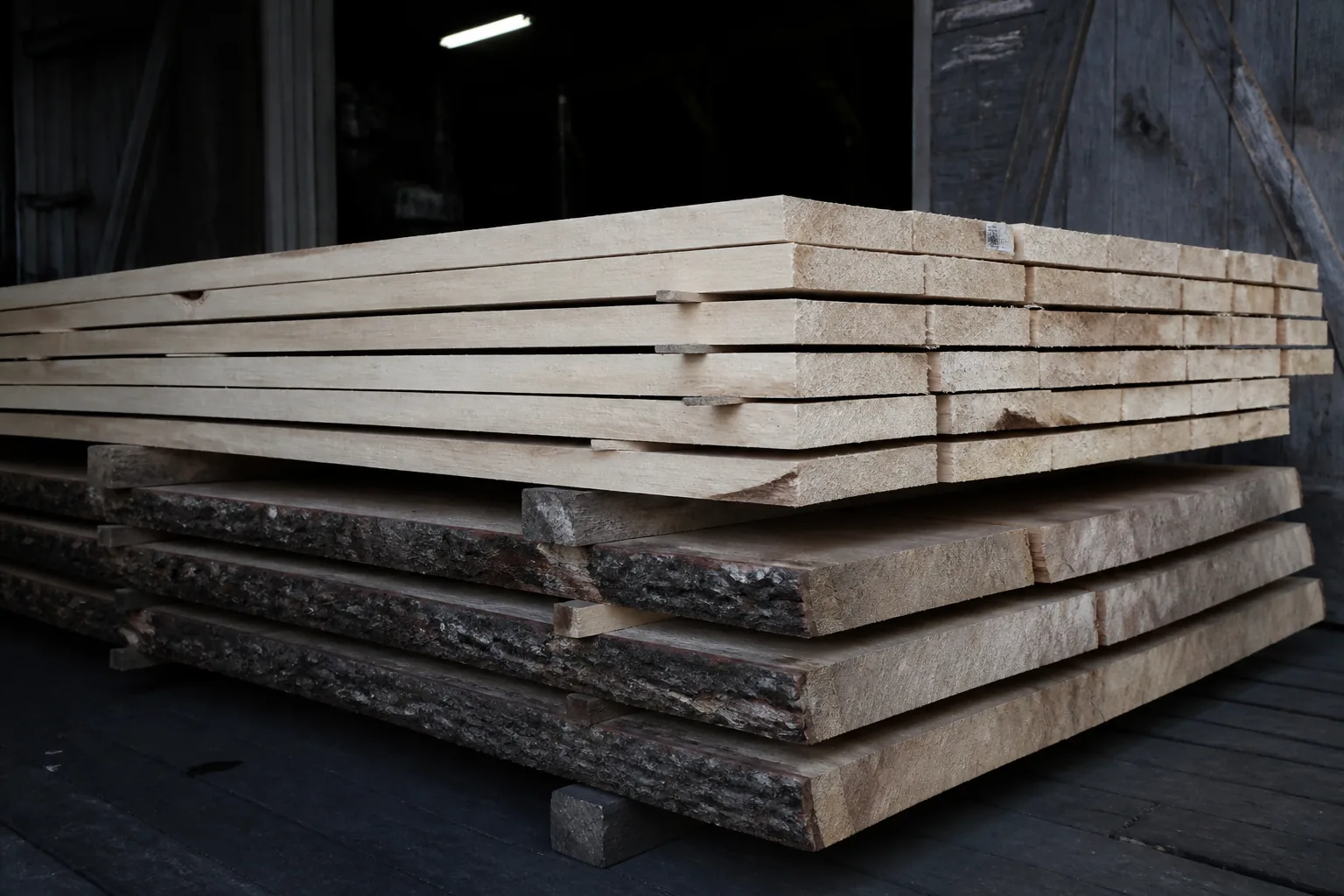
At the edge of a cutblock, the evidence of the forest is small enough to hold between two fingers.
A twig.
A broken cone.
A cross-section of a stem with rings closing around a dark centre.
That is not the forest that has been counted.
The counted forest is a dated description assembled from plots, photographs, sensor returns, interpreted polygons, and records of treatment and disturbance. Saskatchewan’s Forest Resource Inventory carries cover, terrain, height, diameter, basal area, volume and stem density, together with mapped land classes, site conditions and a way to project volume.
None of those entries is an allowable cut.
An allowable cut is what happens after the entries are made to move through time.
That distinction sounds administrative.
It is biological.
The Prince Albert Forest Management Agreement area is one place where it becomes visible. A right to harvest Crown timber is not a claim on a pile of standing trees. It is attached to an approved long-range plan, an allocation instrument, operating decisions, renewal duties, and a forecast of the forest those decisions leave behind.
The number that emerges is not a count of what is there.
It is a claim about what can be removed while a specified future stays possible.
The forest on the map has a date
A map coloured by stand age, species or timber volume suggests a forest has been measured once and is now available for arithmetic.
It has not.
An inventory has a source date.
A field plot records a tree list, deadwood, regeneration, treatment history and disturbance history at the time of observation. Imagery and laser scanning extend the view across the landscape. They do not remove the need to calibrate mapped attributes against plots.
Saskatchewan procedure requires the inventory date to be reconciled to the planning start date by adding known harvest, fire, pest and road changes.
The original date stays in the record.
A derived current layer has to keep a lineage back to measurements and assumptions.
That is the first restraint on an allowable cut.
The inventory says what was observed.
The supply model says what may follow, if its rules are adequate.
The difference matters at the smallest scale.
A regenerating pocket of a quarter-hectare can matter to a treatment layout and vanish inside a broader landscape age class. National disturbance products map annual change at tens of metres, with a minimum detectable area larger than many retained strips.
A narrow retained strip or a den tree can be absent from the map without being absent from the ground.
More detail does not automatically make the forecast truer.
Sometimes it only makes the uncertainty look sharper.
The model chooses among futures
The inventory becomes a forest estate only when each stand class is given a pathway.
Growth, succession, mortality, regeneration, treatment, disturbance transitions.
Species share has to be complete within a stand attribute, because a component treated as minor can still decide host susceptibility, decay, regeneration or fire response.
Then the planner has to run more than one future.
Saskatchewan procedure calls for a reference future with no new management action, and one or more futures under proposed management. They have to carry the same disturbance assumptions and the same reporting rules. Otherwise the comparison does not distinguish management from a change in the rules of prediction.
Each scenario follows age, species composition, volume, disturbance transitions and spatial pattern through periods.
Does mature cover stay connected?
Does the treatment sequence create one large young cohort? Does regeneration reach the structural condition the scenario needs? Does a road network make the action possible without changing a different value beyond recognition?
The allowable cut lives inside that conditional map.
It is not a biological command.
It is not the annual harvest.
It is not a licence to take every tree included in a volume layer.
A forest management agreement generally runs on a 20-year horizon, and in Saskatchewan the management plan is redeveloped every 10 years. An area-based timber sale licence can run for a decade where a plan is in place.
A volume-based licence normally runs a few years.
A commercial forest-product permit is annual.
None of those clocks is a rotation age.
None is an inventory date.
They are different ways of making time govern a forest.
Rotation is a lever, not a verdict
A rotation age is treated as though it answered the question before the model began.
Grow the stand to a stated age.
Cut it.
Start again.
It does not.
An even-aged stand receives one final harvest per rotation, with zero or more intermediate tending entries. An uneven-aged stand may instead receive repeated entries meant to maintain a diameter distribution or a canopy condition. A disturbance-driven stand may need neither sequence in the expected form.
The chosen timing changes the forest that later supplies the cut. A shorter age can reduce time spent in a susceptible host condition while removing late-seral attributes earlier. A longer age can retain larger trees and deadwood while extending exposure to mortality.
Natural regeneration, planting, advance-regeneration protection and species conversion all have different delays.
The question is not simply whether a hectare has been reforested.
It is whether the planned proportion of that hectare reaches the next required structural state inside the interval the scenario assumes.
That is why rotation cannot be separated from silviculture. The future volume is not waiting inside the land. It depends on a chosen regeneration pathway, residual structure, site conditions, productivity, density, species mix and treatment history.
A ninety-year-old spruce stand on a wet organic site is not safely represented by a curve fitted to spruce of the same age on mineral uplands.
Same age is not same forest.
A road makes a prediction operational
Once a scenario is selected, the calculation leaves the model and keeps its conditions. The stand has to be checked again, in the field or with current imagery.
Boundary, access, sensitive features, structure, regeneration, fuel condition.
Saskatchewan procedure wants a treatment record for each management unit. It carries the before-condition, the objective, retained structures, seasonal windows, operational exclusions, regeneration method and next observation.
The record lets the next inventory distinguish a planned density change from storm mortality. It is how a landscape model survives contact with a machine operator.
Roads are part of that survival.
A route can make thinning or harvest feasible.
It can also alter edge, access, human ignition opportunity, or disturbance to a seasonal use. In woodland caribou range, Saskatchewan operating-plan standards require harvest-event planning that aggregates disturbance, minimizes road networks and maps habitat-management areas.
The road is not a line drawn after the allowable cut has been set. It is one of the assumptions that decides whether the selected future can exist.
This is why a harvest event is more revealing than a single cutblock. It can include several harvest areas, related access and renewal as one connected disturbance unit. A Prince Albert annual report aimed to concentrate most harvested area in events of a few hundred hectares.
That is a report-specific target, not a provincial threshold.
Its value is conceptual.
The operational disturbance is not always the polygon.
The forest model creates a road case.
The road case creates the next forest.
Disturbance is input and consequence
Fire and pests enter an allowable-cut calculation as disturbance assumptions. The phrase makes them sound like a column in a spreadsheet.
They are not.
The Canadian Fire Weather Index system runs on daily temperature, relative humidity, wind speed and rain. Those feed moisture codes and spread or intensity indices. They are not percentages of an abstract fire risk. Fuel continuity, topography, ignition sources and the location of values at risk stay separate variables.
For pests, the relevant variables are host abundance, age or vigour, observed population or damage class, outbreak trend, connectivity and the feasibility of response.
An intervention threshold is pest-specific and jurisdiction-specific.
It cannot be carried from one insect, host or programme into another because both are called forest pests.
When a disturbance is detected, Saskatchewan procedure keeps three decisions apart.
Classify it and map its extent.
Assess consequences for safety, regeneration, fuels and values.
Then decide whether to monitor, protect, treat, salvage or revise the scenario.
That separation is more than tidy process.
A fire perimeter is evidence of fire.
It is not a salvage prescription.
A visible insect is evidence of an insect.
It is not proof of an outbreak.
The planning standard requires a description of fire events above a stated size, and other disturbance events above a smaller one, over the preceding seven years.
That is a reporting rule.
It is not permission to create a disturbance of any size, and not a universal ecological threshold.
After material disturbance, the stand state changes and the scenario has to run again.
The forecast has met the forest.
A log enters another account
The cut is not the end of the calculation.
In Saskatchewan Crown forestry it is a handoff.
Logs are scaled at roadside or another authorized point. Scaling determines harvested volume for reports, dues and fees. It is the bridge from physical timber to the public record of allocation use.
The licence holder reports scaled volume and remits Crown dues and forest-management fees. A recent provincial schedule lists a forest-management fee of $5.20 per cubic metre for softwood.
That number belongs to a schedule, not to a growth model.
It joins the same chain anyway.
A discrepancy in scale affects commercial payment, utilization records, and the account from which renewal duties are traced.
Those duties outlast the log delivery.
An agreement holder has to reforest its own harvest, and areas harvested by volume-based licensees or permit holders inside its licence area. Harvested sites have to meet the regeneration assessment standard at 7 and 14 years after harvest.
Saskatchewan describes sufficient regeneration at year 14 as trees on 80% of available growing area reaching species-dependent heights of 1.5 to 2.0 m.
This is the biological lag concealed by annual numbers.
The harvest year can close while the renewal question stays open for fourteen more.
Certification, where held, adds annual surveillance audit.
It does not replace provincial enforcement.
Legal compliance, plan implementation, scaling, silviculture evidence and certification are connected records. They are not one verdict handed down at the stump.
The next cut depends on the last prediction
Forest management is often described as sustained yield, as though sustainability were a stock of trees carefully portioned out each year.
The more exact description is recursive.
A dated inventory supplies a model.
The model sets a conditional supply constraint.
The constraint informs operating plans, roads, harvest events and treatment records. Those actions change stand structure, access, fuel, regeneration and disturbance exposure.
Scaling records what was removed.
Renewal assessment tests what followed.
The resulting observations revise the next inventory and its growth assumptions.
The annual allowable cut sits inside that loop.
It is tempting to call it a pile of trees, because piles are visible, tradable and easily compared. The valuable thing in the calculation is not a pile.
It is a proposition about a living landscape that has not yet happened.
That proposition can be useful.
It can organize cutting, roads, renewal work, public reporting, fees and certification around a common future condition.
It can also be wrong in the ordinary ways forecasts are wrong.
A fire takes a different path.
A pest moves differently.
Regeneration is slower.
A road changes access.
A market changes what is actually harvested.
A growth curve is applied beyond the forest it was learned from.
The remedy is not to abandon the model.
It is to remember what it is.
An allowable cut is not the forest.
It is a model of the forest that harvest will help create.