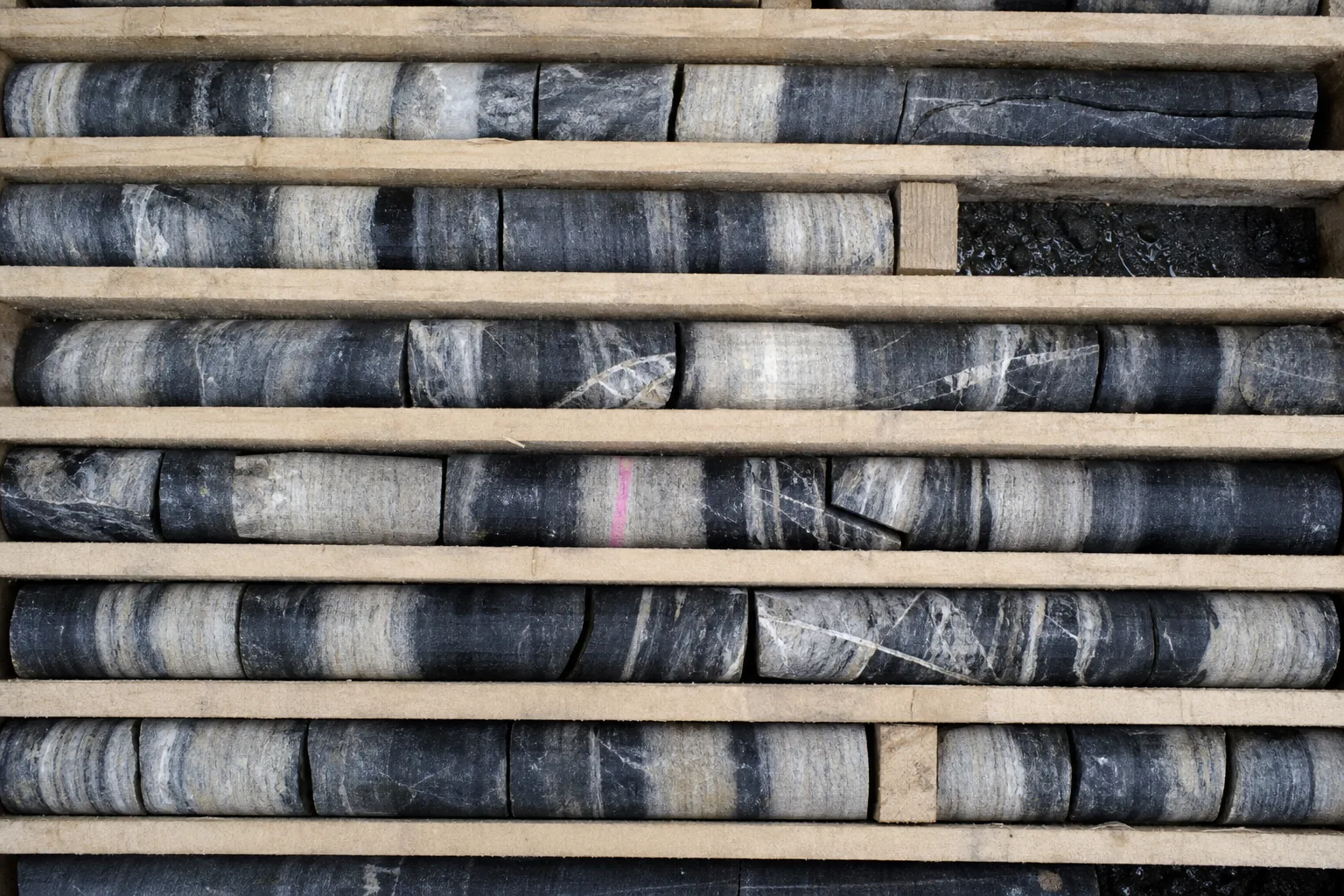
At an exposed Precambrian outcrop near La Ronge, a freshly broken surface can show pale and dark mineral bands at the scale of a hand lens.
Not metaphorically.
Not as a landscape version of a life with light and dark passages.
The bands are material.
Quartz and feldspar concentrated in one layer, darker ferromagnesian minerals in another, each component arranged in a fabric that can be measured.
The rock may be called gneiss.
That is useful.
It is also a statement with hard limits.
A USGS geologic-map vocabulary describes layered gneiss as having continuous compositional layers more than 5 mm thick and traceable for more than 10 cm. Those dimensions make a fabric auditable.
They do not disclose every pressure increment, fluid pulse or episode of strain that occurred before the surface was exposed.
A name is assumed to summarize a history.
It does not.
A rock name describes what survived.
An observation has a size
The first question is not what to call the outcrop. It is what, exactly, was observed.
The rock record calls this support. A hand specimen, a channel sample, a bed, a core interval, a thin section and a map polygon are different objects of evidence, even when each receives the word gneiss.
A hand specimen can look massive. An exposure can reveal compositional layers. A map unit can gather both into a regional interpretation. No one of them stands in for the rest.
This is less glamorous than a name, and more important.
A loose weathered block can establish a local material observation. It cannot automatically characterize the outcrop it may have come from. A scale bar on a freshly broken face, with an orientation and a sample identifier, can carry more usable information than a scenic photograph of the same exposure.
The distinction protects the evidence from its own shorthand. Bedding, foliation, cleavage, flow banding and joints can be parallel in a particular view. They are not the same attribute.
An attitude measurement needs the feature measured, the method, and the convention by which it was recorded. A map label is already an interpretation at map scale. An exposure log begins one step earlier.
This is the first discipline of petrology. Do not let an inference wear the clothes of an observation.
Granite is an arrangement, not a history
The name granite is used as though it meant pale, coarse and old.
Its actual work is narrower.
Granite is a coarse-grained intrusive igneous rock with abundant quartz and alkali feldspar, commonly with plagioclase, biotite or hornblende.
Granodiorite carries relatively more plagioclase.
Tonalite carries still more, with little alkali feldspar.
A USGS illustrative granite makes the distinction concrete. It is reported at about 70 wt.% silica, and separately as a set of mineral proportions by volume.
The two descriptions agree about a sample without being the same description. The silica result is mass chemistry. The mineral proportions are a mode.
Their denominators differ.
This is why a point count on a slab or thin section can be appropriate for classifying a coarse-grained rock, while whole-rock chemistry supports a name for fine-grained volcanic rock only after analytical method, alteration state and loss on ignition have been considered.
A visual estimate of dark minerals is still useful field evidence. It is not an analysis because it is written in the voice of a number.
The same restraint separates a mineral from a rock history. Felsic magma commonly runs 65 to 75 wt.% silica, against 45 to 55 wt.% for the mafic range. Those contrasts constrain partial melting and differentiation.
They do not make granite simply cooled basalt. Similar broad compositions can arise from different sources and different degrees of melting.
The present composition is real.
Its route to the present is not unique.
Fabric is what escaped alteration
Gneiss is named for a fabric, often alternating light quartz-feldspar-rich and dark mafic layers. The name reports an arrangement of minerals.
It does not decide whether every band began as a deposited layer, formed by metamorphic segregation, or was inherited from a strongly deformed intrusion.
This is not a semantic caveat. It determines what can be claimed from the outcrop.
A rock with visible rounded quartz grains and pore cement retains a sedimentary argument. A quartzite has tightly intergrown quartz and records recrystallization. Quartz sits at Mohs 7 and calcite at 3, which makes a scratch test useful on a fresh representative surface and not decisive.
A hard quartz-cemented sandstone can resemble quartzite. Texture and context do the final work.
The same problem recurs across foliation. Phyllite has tiny aligned mica and a silky sheen. Slate is finer still, with grains below hand-lens resolution. Schist is coarser and visibly mineral-aligned.
Those are reproducible descriptions.
They are not universal grade boundaries, and not a compulsory sequence through which every mud-rich rock has passed.
The band is not a diary.
It is a page that remained after other pages were rewritten.
A facies constrains without replaying
Metamorphic petrology begins where the field name stops. Mineral assemblages can constrain the pressure-temperature regime under which minerals were stable or grew.
They cannot turn a mineral list into an automatic depth gauge.
The thermal gradients give the point a numerical shape. A standard continental geothermal gradient is near 30 °C per kilometre. Volcanic regions can run half again as high. Subduction settings are typically well below 10 °C per kilometre.
At the same depth, those systems produce very different temperatures. At different depths, they can produce a superficially similar assemblage.
Teaching models that assign burial depths to zeolite, greenschist and schist-forming zones are explanatory ranges. They are not a ruler to lay against a hand specimen. Bulk composition, fluid activity and the actual thermal gradient can move mineral reactions substantially.
Even a facies assemblage is conditional. In mafic compositions, greenschist commonly includes chlorite, epidote, albite and quartz.
Amphibolite includes hornblende and plagioclase.
Eclogite includes omphacite and garnet.
A different bulk composition can express the same regime through different minerals. The assemblage is evidence because it is conditional, not because it is a label with authority of its own.
Contact metamorphism states the same limit from another direction. It spans roughly 300 to over 800 °C, with aureoles ranging from centimetres around a small dyke to tens of metres around a large stock.
Those figures frame a question about heat, distance, country rock and texture. They do not license an unmeasured temperature for a northern Saskatchewan outcrop.
Texture supplies order, not a date
Some of the best evidence in a rock is relational.
An inclusion enclosed by a host is normally older than host growth. A reaction rim is later than the mineral it replaces. A fracture or vein cutting earlier phases is younger.
These are not guesses about atmosphere or colour. They are physical relations visible at the grain scale.
The inference is modest and powerful. A primary plagioclase crystal partly replaced by epidote remains evidence of two episodes where texture and chemistry support the distinction.
Magmatic growth first, alteration later.
The late phase should not be averaged into the original rock name. Nor should the youngest visible alteration be used to infer the original magma.
Grain size can also preserve a change. A rock with two discrete crystal-size populations is porphyritic evidence that cooling conditions changed. Larger phenocrysts formed before the fine groundmass.
But the sequence does not identify a location. It may record early storage followed by eruption, or changing cooling inside an intrusion.
The texture constrains an order.
It does not choose one story where several remain possible.
Independent time information can make that order more useful without making it complete. A dated igneous complex, a thin section from a stated depth below collar, a counted set of polished sections examined by electron microscopy: each says what was sampled, where, and how much material was examined.
None of them turns one set of sections into a full history of the complex.
Chemistry needs a texture
Petrology does not set the hand lens against the laboratory. It assigns each method a different burden.
In one USGS release, thin sections, automated mineral maps, lithogeochemistry and isotope data were connected across a set of mafic-ultramafic outcrops. That combination carries a simple discipline.
A bulk chemistry result cannot see whether it has mixed a primary crystal, a cumulate layer, alteration and a late vein. A thin section can establish whether those materials belong to the same generation, before chemistry is asked to explain them.
The same logic applies to a field identification. Diffraction can distinguish minerals beyond hand-lens confidence. Electron microscopy and elemental maps can locate a phase or a replacement rim.
Mineral chemistry can test composition.
Isotope work can add a clock or a source constraint.
None of those instruments supplies the grain boundary, the crosscutting relation, or the representative sampling decision that gives its result a geological subject.
Evidence accumulates by division of labour. A mineral map says where the phase is. Chemistry says what is in it. Texture says whether it was primary or late. Provenance says which specimen, preparation, instrument, calibration, units and reporting basis produced the result.
Without that trail, a precise number is only a precise orphan.
The outcrop is an address
The outcrops near La Ronge make the general problem tactile. A person can look at compositional banding on exposed crystalline rock and see that a mineral arrangement has endured.
The site does not grant a historian’s confidence merely because the material is old and exposed.
That restraint is especially necessary here. The supplied corpus gives methods for naming material, recording support, mapping facies and testing textures. It does not carry a verified site-specific map, mineral assemblage, chemical dataset, pressure-temperature estimate or deformation chronology for that particular outcrop.
Those claims need provincial survey mapping and primary petrography before they belong in print.
The refusal is not an absence of geology. It is geology keeping its terms straight.
What don’t we know?
The question is not whether the gneissic bands are real. They can be observed at a stated scale, sampled, photographed and measured. Nor is the question whether mineral assemblages and textures can constrain a history.
They can.
The question is which pressure-temperature path, which fluid episodes and which deformation increments produced the observed assemblage. And which earlier evidence recrystallization erased.
Several incompatible histories can leave a similar mineral mode, a similar foliation, or the same broad silica range.
Better sampling and independent measurements shrink the set. A vein that cuts a fabric rules out some sequences. A reaction rim rules out others. A facies assemblage rejects conditions inconsistent with the relevant bulk composition.
None of them can restore an earlier grain boundary dissolved by later reaction, or an episode whose minerals were replaced.
This is the inverse problem in stone. The present material is an effect. The past is a set of possible causes, filtered by everything that happened afterward.
Earth does not retain every event that mattered.
It retains enough to make some histories testable, and loses enough to make no honest reconstruction final.