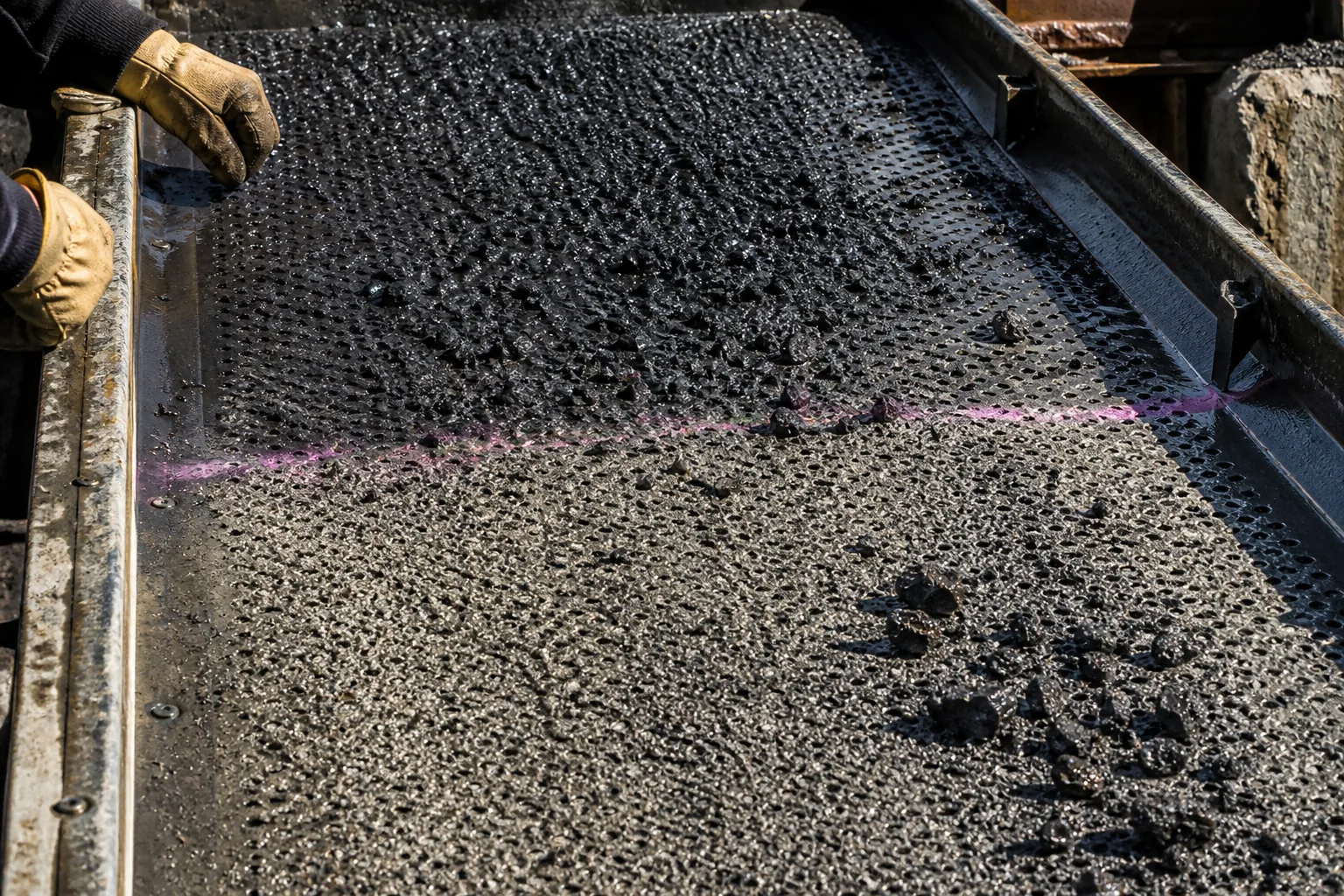
At Cigar Lake, the useful thing leaving the mine is wet, finely ground ore.
Not a metal.
Not a product.
Not even the uranium concentrate usually called yellowcake.
It is slurry.
Ore reduced, classified, thickened, made fit for a shaft pipeline and then a road journey to McClean Lake. There, leaching transfers uranium from the ground ore into solution.
Purification and precipitation come after that.
The material changes state several times before it becomes a package that can leave the mill.
This is not an administrative distinction.
It is the whole problem.
Mineral processing is usually described as breaking rock until the valuable part can be taken out, with chemistry finishing the job afterward.
Both halves are true.
Both conceal the mechanism that governs recovery.
Every break creates a surface.
Every surface enters water, reagent, air, a magnetic field, a froth, a furnace, or a leach. Every later separator inherits the particle size, mineral locking, surface condition, solution chemistry and rate at which the earlier steps delivered material.
The first alteration is physical.
Everything after it is a chain of separation problems.
A mill does not make metal free
Run-of-mine ore arrives as fragments holding minerals that may still be locked together. The valuable mineral can be present in a particle without being separable from the gangue around it.
Crushing reduces top size.
Grinding makes the finer break required to expose the relevant surfaces.
It is liberation, not manufacture.
An early design decision gives the trade its hard arithmetic. A grind target of 150 µm is not only a number in a flowsheet. It is a demand for power, grinding media, liners, water, classification capacity, and enough time in the mill to reach it.
Harder ore interrupts the apparent simplicity.
At one feed rate it makes the product coarser.
Holding the product size means lowering throughput.
Published work-index datasets from a single deposit can span a wide range, which is why a stockpile, classifier and blending plan has to absorb ore domains with different breakage response.
The rock is not becoming more valuable as it becomes smaller.
It is becoming more expensive to ignore its texture.
Classification decides what is finished
Grinding normally runs in a loop.
A classifier sends fine overflow forward and returns coarse underflow to the mill.
Without the return, coarse composites reach a separator before their target mineral is exposed. Without the forward exit, already-fine particles stay in the mill, consuming energy and creating excess fines.
This is where a size target becomes a material-routing decision. Mill power, feed rate, water addition, grinding media, cyclone pressure, cyclone geometry and cut size all move together. More water can improve classification while reducing mill residence time. A finer cut can improve liberation while increasing circulating load.
The control is not a knob.
It is a set of conditions that can contradict one another.
The downstream effect is chemical as well as physical. A fine particle has more accessible surface for flotation or leaching. It also changes pulp rheology, and it can entrain into a froth without being the wanted mineral.
A circuit that reports only a nominal grind size has not described the feed its separators actually receive.
At Cigar Lake the underground circuit makes the same principle literal.
Coarse solids settle in run-of-mine sumps.
A cone crusher and ball mill reduce them.
Hydrocyclones classify the product and thickeners raise slurry density.
The output is designed for transfer, not for sale.
Size has become transport.
Transport becomes mill feed.
Roughers ask a broad question
Flotation makes its first choice generously.
Ground slurry is conditioned so collectors, depressants and pH modifiers meet mineral surfaces before aeration. Bubbles then offer floatable particles a route into froth.
The rougher circuit is meant to capture value broadly, including material that will later prove unwelcome.
Residence time is the visible lever.
More time can let a slow-floating valuable mineral report to concentrate. It can also pull more gangue, consume more reagent, and send a larger wet mass to every vessel that follows.
Mass pull is the missing noun in many recovery claims.
It is concentrate mass divided by feed mass.
A higher recovery can mean a separator collected more of the valuable mineral. It can also mean it collected more of almost everything else.
The cleaner circuit makes the opposite decision.
Rougher concentrate is often reground, because target and gangue are still together. A published copper sequence grinds, rougher-floats, regrinds the rougher concentrate to 10 to 20 µm, cleans it, then dewaters the final concentrate.
Cleaner tails can return to a rougher or a preceding cleaner rather than becoming final tailings. The return stream admits that a rejection is sometimes a deferred decision.
Roughers ask whether a particle might be valuable.
Cleaners ask whether it is valuable enough to carry onward.
Grade and recovery are one argument
The usual wish is a small, high-grade concentrate holding nearly all the metal.
Mineral particles do not generally grant it.
Pulling more material toward concentrate commonly raises recovery while admitting gangue. Rejecting more commonly raises grade while leaving valuable mineral behind.
Bornite locked-cycle results put the trade-off in a narrow frame. Concentrates from 26.4% to 36.9% copper paired with recoveries from 76.1% to 90.3% across composites.
The two ranges should never be quoted separately.
They are not rankings of performance.
They are choices made under different feed conditions.
The chosen point reaches well beyond the flotation cells. A lower-grade product may be viable if the extra recovered metal stays payable after transport and treatment. A high-grade product may destroy value if it abandons too much metal or a co-product.
The concentrate’s moisture, sulfur grade and impurity content can then change the heat balance and treatment route of the smelter that receives it.
This is why a concentrator cannot optimize only itself.
Its product is somebody else’s feed.
The grade-recovery curve continues in freight, furnace balance, acid-plant operation, slag cleaning, and the residue routes that keep a smelter from being an unfinished description of hot metal.
The product exits the mill.
The separation does not.
Leaching moves the problem into water
Some minerals never go to a smelter.
Prepared ore can be contacted with leach solution so the target metal enters an aqueous phase.
This is a profound change.
It is not the last one.
The metal is no longer locked in a rock particle. It is dissolved among water, reagent species and impurities that have to be managed before a product can exist.
Heap leaching shows the continuity at scale.
Ore is crushed, often agglomerated, stacked on a lined pad, irrigated, drained and collected as pregnant leach solution. Lift height, cyanide strength, crush size, percolation and time cannot be separated into independent claims.
Change one and the others answer.
Agitated leaching trades the heap’s percolation for a controlled slurry residence. In a carbon-in-leach circuit, carbon moves counter-current to slurry, takes up dissolved gold, is eluted into a concentrated electrolyte, and returns after regeneration.
The sequence marks an important boundary.
Leaching dissolves.
Adsorption and elution concentrate.
Electrowinning and smelting finish a product.
At McClean Lake the same boundary explains the mill hand-off. Cigar Lake slurry is unloaded, thickened and held before chemical treatment.
Leaching moves uranium into solution.
Purification separates unwanted constituents.
Precipitation forms a uranium-bearing solid.
Drying and packaging produce uranium ore concentrate.
The mill’s front-end leach and counter-current-decantation circuits were expanded from a nominal 45 kt of ore per year to 59. An ore panel can be ready while the binding constraint is still the mill.
Mining has become an inventory problem in tanks, containers and solution circuits.
Chemistry chooses the branch
Once a metal is in solution, concentration is the next decision.
Ion exchange loads the target onto resin, then strips it into a smaller eluate volume. Solvent extraction contacts aqueous solution with an immiscible organic phase. The target transfers, the organic is washed and stripped, and the aqueous raffinate returns to leaching.
Both routes concentrate.
Their constraints are not the same.
For uranium, the IAEA describes uranyl complexes loading to either resin or solvent. Chloride can constrain resin loading, because competing ions consume sites before the target arrives. Above a solution-specific chloride level, solvent extraction may be the more economical route.
That is a chemistry and capacity result.
It is not a universal rule about chloride.
The leach itself is equally conditional.
In uranium in-situ leaching, the choice between acid and alkaline chemistry turns largely on carbonate content: acid below a threshold, alkaline above it.
The threshold belongs to that uranium context.
It cannot be lifted into copper, nickel or gold practice as a generic acid-consumption test.
Reagent concentration, dissolved oxygen, mineral surfaces, flow, residence time and impurity loading form a coupled system. A reagent dose cannot compensate indefinitely for inaccessible mineral, inadequate oxygen delivery, or a slurry that short-circuits.
The solution is concentrated.
The constraints are concentrated with it.
Electricity exposes the upstream
Electrowinning looks like the clean end of the chain.
Metal-rich electrolyte enters a cell.
Current passes.
Metal plates onto cathodes.
Spent electrolyte returns to stripping or circulation.
The visible product can obscure how much of the cell’s behaviour was decided before it arrived.
Current density determines production rate per electrode area, but only while dissolved metal reaches the cathode fast enough. Concentration, acid balance, temperature, circulation, additive regime, electrode spacing and deposit growth determine whether that condition holds.
If current outruns mass transfer, the deposit becomes rough, nodular or powdery, and energy per kilogram rises.
Narrower electrode spacing can reduce voltage loss and also reduce room for deposit growth. Higher current can raise output and also expose depletion at the cathode surface. A short clean test can miss the solids, acid-balance changes and effective spacing loss that emerge over a full cathode cycle.
The cell receives electricity.
It receives every upstream decision as well.
A residue is a stream with a history
The final product is never the only output.
Rougher tailings, cleaner tails, thickener underflow, spent heap material, raffinate, slag, flue dust and leach residues all carry the consequences of the earlier route.
A flow diagram that ends at concentrate, metal or yellowcake has stopped before the material balance is complete.
That is not a charge against any recovery route.
It is its physical accounting.
A smelter needs gas cooling, particulate capture and, where designed, sulfuric-acid manufacture, because furnace off-gas carries dust and sulfur dioxide. A heap needs lined pads, solution collection, rinse and solution-inventory management. A uranium mill sends solid residues to a tailings-management system while its process solutions stay constrained by chemistry and radiation characteristics.
The cascade is economic as well as material.
A harder ore changes grinding energy.
A finer cut changes circulating load.
A broader rougher pull changes concentrate tonnes and cleaner duty.
Impurity transfer changes leach consumption or smelter balance.
A lower solution concentration changes the volume the recovery circuit has to carry.
A mill bottleneck can slow a mine before the orebody becomes the constraint.
The first operation breaks rock.
Everything after that is an argument about where the metal, water, energy and residue will go.
What don’t we know?
No single test says how a full circuit will behave when the ore changes.
A grind study can show liberation response.
A flotation test can show a grade-recovery relationship.
A leach test can show reagent consumption and extraction for its sampled material. An ion-exchange or solvent-extraction trial can show loading under its solution chemistry.
Each is evidence with a defined feed, a defined time and a defined boundary.
The missing question is how those responses move together across ore variability.
A harder domain shifts the grind.
That shift changes fines, flotation kinetics and reagent demand. A change in concentrate mineralogy alters smelter heat balance. A change in leach feed changes impurity loading, which can change resin capacity or the economics of solvent extraction.
The circuit does not experience a composite.
It experiences a sequence of variable material.
This is why the relevant test programme is not a collection of attractive recoveries. It is a connected model of particles, water, chemistry, recirculation and products, checked against representative ore domains and updated as operations reveal their differences.
Liberation is the beginning of recovery.
It is also the beginning of every downstream constraint.