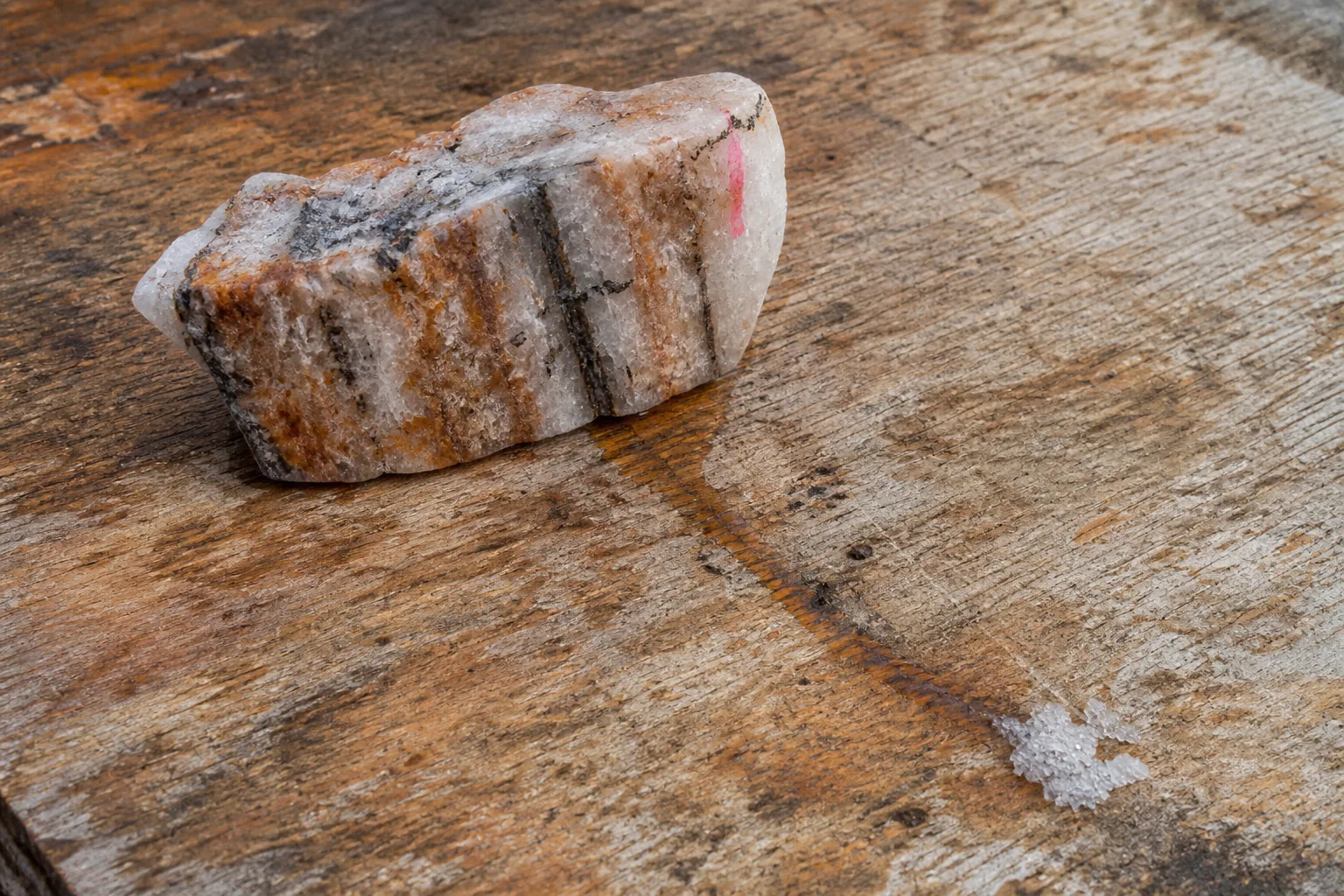
There are two potash zones at Lanigan that lie only a short distance apart, with four to six metres of tabular salt between them.
Not metaphorically.
Not as two entries in a resource spreadsheet.
The A Zone and B Zone in the Patience Lake Member are physical layers, and Nutrien says only one is mined in a given block.
That interval of salt is the first mine plan.
It tells the engineer the target is not a broad underground shelf waiting to be removed.
It is a geometry.
A layer, a separation, a choice of working level, a volume of salt that has to stay where it is, and another mineralized interval that may belong to a different part of the schedule.
The comfortable version is that Saskatchewan has potash.
It does.
The Prairie Evaporite’s laterally extensive beds made high-throughput underground mining possible across the province, and the tonnages are among the largest in the world.
But a basin is not a mine.
A member is not a working face.
A mineral is not a product.
A resource is not the industrial system built to reach it, separate it, sell it and eventually retire it.
A name true at the wrong scale
The Prairie Evaporite contains three mineable members in the Saskatchewan terminology Nutrien uses: Patience Lake, Belle Plaine and Esterhazy.
They are stratigraphic names.
They say where in a salt succession a target occurs. They do not say which local zone is cut, what arrives at a mill, or what a buyer receives in a railcar.
At Lanigan, both A Zone and B Zone belong within the Patience Lake Member. Elsewhere in the same member, other operations principally mine A Zone.
The member establishes a geological address.
The zone narrows it.
At the Saskatoon-area Patience Lake operations, Nutrien gives an A Zone thickness of about 3.35 m. That is not a product grade and not a ranking of the members.
It is a working height.
The difference matters.
Saying where a material is and saying what can be done with it are separate claims.
Conventional Saskatchewan operations in Nutrien’s disclosure work around a kilometre down. At that depth, access, stable salt cover, ground conditions and water-inflow pathways become part of the resource definition in practice. A collapse structure is not merely an interruption on a map.
It can be a water-inflow pathway.
A horizon that looks continuous in section may become an avoidance zone in a mine.
The bed does not get the final word.
Continuity is argued between holes
A core has an unfair advantage.
It touches the rock.
It can establish lithology, mineralogy, thickness and grade at the point of sampling. Wireline logs supply a continuous physical response down a hole, but they need calibration to core. Seismic extends the picture between holes, identifying horizons and anomalous structures.
Each observation answers a different question.
Nutrien says its Saskatchewan measured-resource tonnage is generally within 1.6 km of a physically sampled drillhole or mine working. That is not a magic radius inside which uncertainty ceases.
It is an admission of the problem.
Sampling makes a local claim.
Seismic and geological interpretation make a spatial one.
The gap widens in a salt body altered by dissolution or movement.
A core cannot prove continuity beyond its interval.
A seismic horizon cannot assay potash.
Collapse, faults and water-bearing anomalies can make the same nominal thickness mean something materially different from one block to the next.
Two assay contexts should also stay apart.
Exploration drillhole grade supports a resource estimate.
Mill-feed grade describes material that has already passed through mining, dilution, sampling and stockpiles.
The first is a statement about the ground.
The second is a statement about the operation.
Reconciliation is where they have to meet.
Ore is not what a customer buys
Potash language makes the confusion easy.
Potassium is an element.
Potash is the commercial and geological umbrella for water-soluble potassium salts. K2O is the conventional oxide-equivalent basis for reporting potassium. None of those terms identifies the material in a rock or a bag.
Sylvite is potassium chloride.
Carnallite is a hydrated potassium magnesium chloride.
Sylvinite is ore rock in which sylvite is mixed with halite; carnallitite is the corresponding carnallite-bearing salt rock.
The extra letters in sylvinite carry the sodium chloride, and the sodium chloride is the separation problem.
That problem has an industrial consequence.
A conventional mine brings solid ore to the surface, then separates potassium chloride from halite and insolubles by flotation or crystallization. A solution mine dissolves salts underground and brings brine to the surface, then crystallizes its potassium chloride.
Solid ore and brine are two feed states.
They are more revealing than the colour of the eventual product.
A white crystallized product does not prove a mine was solution-mined. The Saskatchewan solution-mining guide notes that conventional mines can also dissolve fine potassium chloride and crystallize it. Appearance arrives at the end of a recovery route.
It does not identify the beginning.
Nutrien’s white granular product makes the separation visible.
Its data sheet is a list of shipment attributes: nutrient guarantee, moisture, chloride, sodium chloride, bulk density.
Those are shipment attributes.
They tell a blender, spreader, terminal or buyer about material delivered after processing.
They do not describe an A Zone in place.
The ore is there.
The saleable product is made.
Dissolution makes it a water system
Solution mining makes that distinction literal.
It does not excavate solid ore as the primary feed. It changes the physical state of salt underground, moves the resulting brine through wells and piping, then recovers potassium chloride at a crystallizer.
The Saskatchewan guide describes the sequence in two stages. Heated fresh water first dissolves halite and sylvite together.
Later, heated brine already saturated with sodium chloride dissolves potassium chloride more selectively, while a little sodium chloride precipitates back out. The second stage runs at a lower cavern production rate.
It increases formation recovery.
So the choice is not simply underground mine against wellfield. It is a choice of which problem becomes central.
Conventional mining requires underground access, development, solid-ore handling and spatial control of the horizon. Solution mining substitutes wells, piping and caverns, then puts hydraulic containment, cavern geometry, water and heat balance, brine chemistry, well integrity and closure at the centre of the operating case.
The salt is no longer only a bed.
It is a dissolved feedstock moving through a connected system.
This is why a laboratory solubility result cannot be called plant recovery. Production recovery depends on brine composition, solid contamination, circuit availability, evaporation or cooling conditions, and product-size cuts.
There are two mass-balance boundaries.
One is the amount excavated or dissolved from the resource. The other is the potassium captured in finished product.
A project can perform differently at each.
The plan is a chain of constraints
Mine development begins with alternatives, because the resource does not choose its own industrial form.
A scoping loop builds cases that differ materially in mining approach, processing route, throughput, footprint, water source or waste strategy. Each case has to name the assumption that could invalidate it.
This is not delay before the real work.
It is the real work.
At pre-feasibility the preferred case becomes one integrated basis of design. The mineable model, metallurgical and geotechnical work, extraction layout, plant, waste, tailings, water, power, construction schedule, approvals and closure requirements all have to describe the same future operation.
If the plant rate needs a power line that cannot arrive on the construction schedule, the plan has not converged.
Estimate-classification systems put a number on that idea, and the classes deliberately overlap. A project can have mature civil quantities and unresolved metallurgy at the same time.
It is not defined by its most finished drawings. It is controlled by the unresolved deliverable capable of changing the mine method, plant capacity, footprint or closure approach.
Under the CIM Definition Standards, a preliminary feasibility study evaluates a range of options, while a feasibility study evaluates a selected option at higher confidence. The movement is from possibility to a particular arrangement of equipment, flows, ground and time.
That arrangement reaches far beyond the horizon.
Higher throughput can mean more mining faces, power, process water, tailings deposition, waste capacity, workforce, logistics and a different final landform.
A plant debottleneck can fail because mining cannot supply it. A new zone can be constrained by a shaft, a tailings facility or a water licence.
The rate is never merely the rate.
First product proves less than it looks
Construction has a deceptively clean ending called mechanical completion. It means a system is complete enough for formal handover.
It does not mean operating tests have proved that utilities, controls, safe operating envelope, product quality, recovery, water balance and materials handling will hold together at rate.
That proof is commissioning, and it proceeds by constraint.
Ore enters at limited rates.
Sampling and reconciliation precede the next increase.
The first binding constraint is removed, the connected system is tested again, and only then are more mining areas, equipment or shifts added.
The definition of commercial production should exist before that sequence begins. At Rainy River, New Gold declared it after thirty days above a stated fraction of nameplate capacity, and disclosed the processing average it had actually achieved.
That is one company’s convention, not a universal threshold. Its value is that it makes the claim checkable: a denominator, a duration, and a rate that can be compared with them.
Salt does not care when the project calls itself operating.
Closure begins during production
There is a temptation to treat closure as the last chapter, because it happens last.
Saskatchewan’s mining-development guidance refuses that chronology.
A conceptual decommissioning and reclamation plan is required as part of the assessment of a mining development.
The obligation changes the first plan.
Drainage, cover materials, seepage collection, water treatment, building removal, openings, revegetation materials and future land use become design variables while the mine is still an option.
Expansion changes them again, because expansion changes the physical scope that eventually has to be stabilized and monitored.
The province requires the operational plan to be reviewed at least every five years, and sooner after a significant change. These are not environmental sentiments attached to a finished mine. They are timing and evidence requirements inside the asset’s life.
Care and maintenance is a different thing.
It is a controlled temporary state that keeps inspection, maintenance, monitoring, records and restart conditions alive. It is not closure postponed by a change of vocabulary.
The consequence is easy to miss, because salt mining is usually described as an extraction problem.
It is a design problem.
It begins with layered geometry and ends with an engineered landform, a monitoring record and a demonstrated stability condition.
The horizon stays complicated
The Prairie Evaporite is laterally extensive.
That fact is real and economically consequential.
It does not make the industrial task simple.
A few metres of tabular salt separate the Lanigan zones. A 3.35 m A Zone is not a generic commodity. It is a particular interval with particular continuity, cover, mineralogy, access and recovery behaviour.
A guaranteed nutrient analysis is not that interval either. It is the far end of a chain: dissolution or excavation, separation, crystallization or flotation, drying, sizing, handling and specification.
Between the two sit drills, seismic interpretations, mine layouts, water systems, wells or rooms, crystallizers or flotation cells, power lines, schedules, product guarantees, brine-management systems, closure plans, and the physical changes each expansion makes to all the others.
The first-order effect is simple.
Reach potassium-bearing salt.
Recover potassium chloride.
Everything after that is a mine plan.