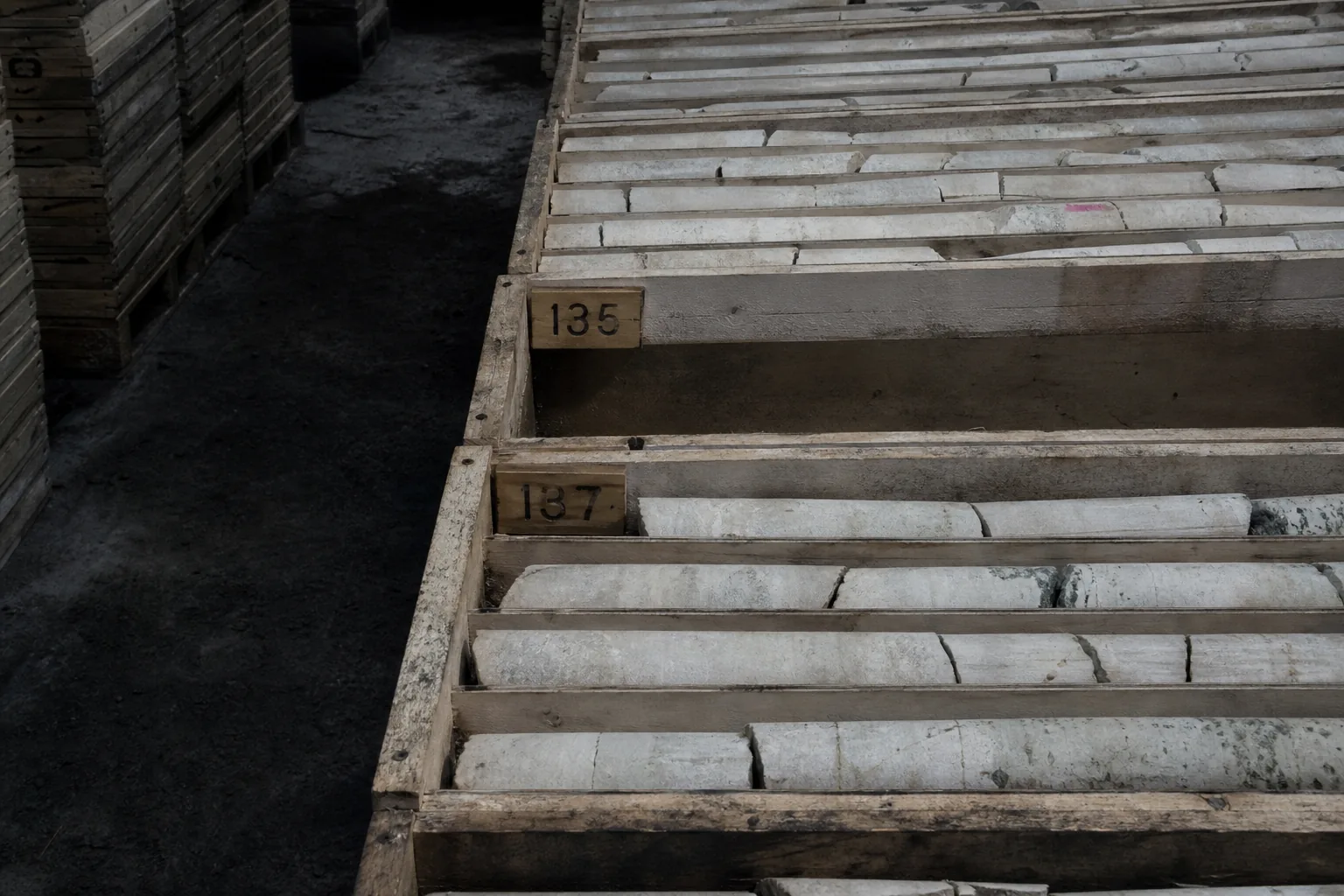
In a drill core, a coarse bed can meet a fine bed so abruptly that the contact is a line under a fingernail.
Not as an ornament in the core.
Not as a decorative stripe in an otherwise uniform resource interval.
The change is material.
Different grain populations, different bedding, perhaps a mud drape, perhaps a scour beneath the next sand. It is depositional architecture at the scale a single grade can obscure.
The Athabasca Basin sandstone succession in northern Saskatchewan is a useful address for this problem.
It is not, here, a completed local facies interpretation. That would need direct Athabasca core, log, petrographic and assay evidence. The point is more general and more severe.
A resource number is not the rock body it describes.
It is a classification imposed on a model of that body.
The usual account runs forward.
The model supplies grades.
The cut-off separates ore from waste. The resulting number tells the plan what exists.
That sequence is real.
It is also backwards in one important sense.
Before a grade can be averaged, thresholded, routed or disclosed, there is a heterogeneous deposit. Grain size has been sorted by transport. Beds have been built, cut and draped over one another. Pores have been compacted, cemented, dissolved or blocked. Sampling has intercepted some of that history and missed the rest.
Mining vocabulary is indispensable, because the plan needs decisions.
It cannot make the variation disappear.
Grain size is a distribution
The first temptation is to call coarse sediment high energy and fine sediment low energy, then treat the conclusion as complete.
It is not.
Coarser particles commonly travel near the bed by rolling, sliding or short hops. Fine material can stay suspended for long periods. But the resulting distribution also depends on source material, turbulence, discharge, grain density, bed roughness, mixing and later winnowing.
A USGS sediment-flux study finds bedload dominated by gravel while the suspended load runs about half sand and half finer material. That is not a river law. It is a warning about support.
A suspended-sediment sample does not stand in for bed material. A bed sample does not stand in for every grain that moved through the system.
The same refusal applies to sorting. A narrow standard deviation of grain size is described as very well sorted. The phrase describes a measured spread. It does not diagnose a beach, a dune or a channel bar.
Repeated winnowing can narrow a distribution. So can a uniform source. A storm layer or a tidal-channel fill can complicate an otherwise tidy setting.
A figure can be exact without being exclusive.
The descriptive conventions show why. Nominal size boundaries put the top of clay near 0.004 mm, with silt above it. Those are useful measurements inside stated datasets. None of them supplies an acceptance range for another deposit, a recovery forecast, or an explanation of a named bed.
Grain size records a population.
The mine needs to know whether that population changes in space.
A bed is evidence with its neighbours
One cross-bed photograph is memorable. One ripple-laminated lamina can be exquisite. Neither is an environment in miniature.
Structures resolve process most strongly in association with the surrounding grain size and geometry.
Cross-strata preserve migrating bedforms.
Grading records a changing grain population. Scour records erosion before renewed fill. Mud cracks record subaerial shrinkage.
Burrows record biological reworking.
Each observation limits the possible histories. No single one closes the case.
A National Park Service guide describes red mudstone units between sandstone facies in a dune-field setting. Thickness alone does not identify a dune field. Thickness joined with grain size, structures and the relationships above and below a bed turns a hand specimen into a depositional body.
This is what a facies model does. It does not assign a romantic name to a rock. It proposes that certain deposits occur together because a process system makes them together. Channel fills and floodplain muds.
Bars and drapes.
Dunes and interdune fines.
Shoreface sands and quieter-water deposits.
The proposal is testable because it predicts neighbours.
That matters more than an isolated average. A composite spanning a sandy bar and adjacent mud yields a mean representing neither.
In a resource model the equivalent failure is quieter. A cell can carry a smooth grade estimate while the material at a smaller support contains a permeability barrier, a coarse lens, a clay-rich bed or a cemented interval that changes what reaches a process boundary.
The smooth number is not necessarily wrong.
It may simply answer a larger question than the operation is asking.
Diagenesis is a second history
There is a further temptation. Infer a rock’s present performance directly from the conditions that deposited it.
That fails whenever the deposit has had time to become rock.
Compaction reduces pore volume.
Cement obstructs pore throats.
Clay can create microporosity while blocking connected flow paths. Dissolution can create secondary pores.
Two sands with similar grain size and sorting can therefore become materially different reservoirs, aquifers, leach paths or process feeds, after different burial, temperature and fluid histories.
A USGS study of the Sussex sandstone makes the separation numerical. It reports about 8.8% average porosity across the sandstone and 13% in reservoir intervals, relating low values to compaction and cement, and higher values to particular facies and cement dissolution. A related characterization gives a geometric average permeability near 0.62 mD alongside that same porosity.
Those are not threshold values for an Athabasca sandstone or for a mine.
They demonstrate the structure of the problem.
Porosity is void volume.
Permeability is the capacity of connected pores to transmit fluid.
They can diverge.
A facies name cannot supply either one. A single laboratory property cannot supply their distribution.
The rock has kept both the depositional fabric and the alterations that overprinted it. The observer has to separate them in relative sequence before asking which properties stay predictive.
That is why a facies model is not a replacement for petrophysics, metallurgy or engineering.
It is an account of the architecture those measurements have to be placed into.
An estimate makes categories
The word resource makes this loss of detail sound administrative.
It is physical first.
An estimate combines observations made at different supports. Core description records an interval in a hole. A thin section records a minute prepared slice. An assay records a sampled material interval. A log supplies a continuous physical response that still needs calibration. A model cell interpolates among controls under stated assumptions.
The result can be disciplined and useful without turning those supports into the same thing.
Published porosity conclusions can rest on dozens of thin sections. The count is not a requirement. It makes the principle visible. A single photogenic slice cannot establish the distribution of fabric across a large body. Sampling density has to follow heterogeneity and the decision at risk.
Core has an unfair advantage.
It touches the rock.
It also has an unfair limitation. It touches only the rock it intersects.
Away from core control, facies continuity and diagenetic alteration have to be inferred from other evidence. This is an inverse problem.
Present measurements are effects.
The depositional bodies and alteration histories that produced them are causes.
Several arrangements can produce similar log responses, average grades or apparent sand content.
No terminology repairs missing resolution.
It can only make the decision boundary visible.
A cut-off decides a route
Cut-off grade is made to carry too much philosophical weight. It is neither the deposit’s natural boundary nor the material’s assay.
It is a selected minimum grade or value used for an economic or operational decision. Material at or above it may become ore, stockpile feed or process feed. Lower material may be waste, marginal material, or a later opportunity.
The threshold depends on recoveries, prices, costs, routing, capacity, and sometimes the plain fact that material has to be moved to reach better material.
CIM guidance distinguishes break-even, mine-design, reserve-reporting, open-pit discard, operational or marginal, stockpile and underground incremental cut-off grades. Those modifiers are not decoration.
An open-pit discard threshold assumes material is excavated within a pit shell. An underground incremental threshold assumes it belongs to an underground design and has to reach surface.
Removing the modifier removes the decision context.
The threshold may also be value rather than metal content. Phase-delineated resources at Galore Creek use a net smelter return per tonne as the cut-off. Calling that a percentage grade would not merely be imprecise. It would exchange a value basis for a metal-content basis and keep neither.
This is where geological variation returns. A selected threshold operates on estimates, recoveries and routes assumed to be meaningful for a material population.
If fine beds, cement, clay, grain-size changes or alteration domains alter recovery between samples, the cut-off has not discovered that difference. It has inherited the consequences of whether the model captured it.
The cut-off makes a plan manageable.
It does not make the ground homogeneous.
Head grade reports a stream
Head grade is the grade of material entering a defined processing operation or test. Crusher feed, mill feed, flotation feed, leach feed, a laboratory composite.
The boundary has to be named, because head identifies where the measurement occurs.
It is not a more authoritative synonym for grade.
Run-of-mine grade, head grade, concentrate grade and tail grade belong to a material balance at different locations. Head grade is often lower than a selected in-situ ore grade, because dilution admits wall rock. It can also be smoothed by stockpile blending, changed by ore loss and mining sequence, or affected by moisture convention and sampling.
A plant can process its planned tonnes and still miss its head-grade target.
Throughput and grade answer different questions.
Units have to make that plain. Precious-metal grades are expressed in grams per tonne, base-metal and iron grades in weight per cent, throughput in tonnes per day, value cut-offs in dollars per tonne. A weight per cent that describes a high-grade iron concentrate does not become a head grade unless the named feed boundary and commodity support the statement.
The same sentence can contain a drift at 0% grade and a mill grade. Without qualification the word disguises two unrelated meanings: longitudinal gradient, and material quality.
Precision begins by refusing that collision.
A strip ratio is a relationship
Strip ratio is another useful number easily made vague. It is the relationship between waste or overburden moved and ore exposed or mined, usually in surface mining.
It records a burden of access. Drilling, blasting, loading, hauling, placement, and often slope-management consequences.
It does not measure contained metal.
The explicit form is 2 t waste per t ore, conventionally written 2:1. The numerator, denominator and basis are all visible. A bare 2 is unusable without the table’s scope and units.
It could refer to a bench, a phase, a pit shell, an annual schedule or a life of mine. It could use wet tonnes, dry tonnes, bank cubic metres or loose cubic metres.
Those bases cannot be silently substituted. Bank and loose cubic metres are different volume bases. Waste rock is material removed to access ore.
Tailings are processing residue.
A truck payload is fleet capacity, not a strip-ratio unit.
The discipline is the same as it is for facies.
Name the population.
Name the boundary.
Name the support.
Name the basis.
Then state what has not been resolved.
What don’t we know?
At the Athabasca sandstone succession, the useful unanswered question is not whether sandstone can be described.
It can.
The question is how facies continuity and diagenetic alteration vary away from core control, and whether the sampling support resolves the features that affect recovery or grade.
The local answer needs primary data the corpus does not carry.
Depth-tied core.
Calibrated logs.
Petrography.
Assay intervals.
Processing or recovery tests.
The stated model and reporting assumptions.
The difficulty is not merely that more data would be desirable. Different evidence samples different things.
A thin section may expose cement in one slice. A log may smooth the response across an interval. An assay may measure chemistry while missing the architecture that changes handling or recovery. A grade estimate can be appropriate at its selected support and still fail to predict a smaller-scale feature that matters operationally.
That is what makes the problem ill-posed. Several depositional and diagenetic histories can be consistent with a similar present measurement. More data help only when they are independent, properly located, and taken at a support capable of testing the alternative.
Representative is a claim about support, not a compliment paid to a sample.
The operational vocabulary is still necessary. National Instrument 43-101 requires estimates and assumptions to be described within its disclosure framework, including a preferred cut-off scenario where several are given.
That framework should keep a disclosure category distinct from a truck destination, a plant-feed stream and a physical block of rock.
It does not remove the work of relating all three to geological architecture.
The number comes last
The physical contact in the core comes first. Coarse and fine material, one bed against another, a boundary that may affect connectivity, handling or recovery.
Then come distributions, structures, associations, compaction, cement, dissolution, assays, logs, interpolation, model cells, cut-offs, routes and feed measurements.
Each step is useful.
Each discards or aggregates something from the step before it.
The loss is not necessarily an error. A mine plan cannot operate on every grain and lamina individually.
But it has to know what its reductions have hidden.
Sedimentary architecture controls what a resource number means, because it governs the material population the number was estimated from. Head grade reports what reaches a named process boundary. Cut-off grade names the rule that admits or rejects material under stated assumptions. Strip ratio describes the access burden associated with ore.
None of them is a facies model.
The number can be robust. The threshold can be well chosen. The stream can be accurately sampled.
And the deposit can still contain a bed boundary, an alteration domain or a continuity change lying between the points where certainty was earned.
That is not a reason to abandon the number.
It is a reason to remember what it is made of.