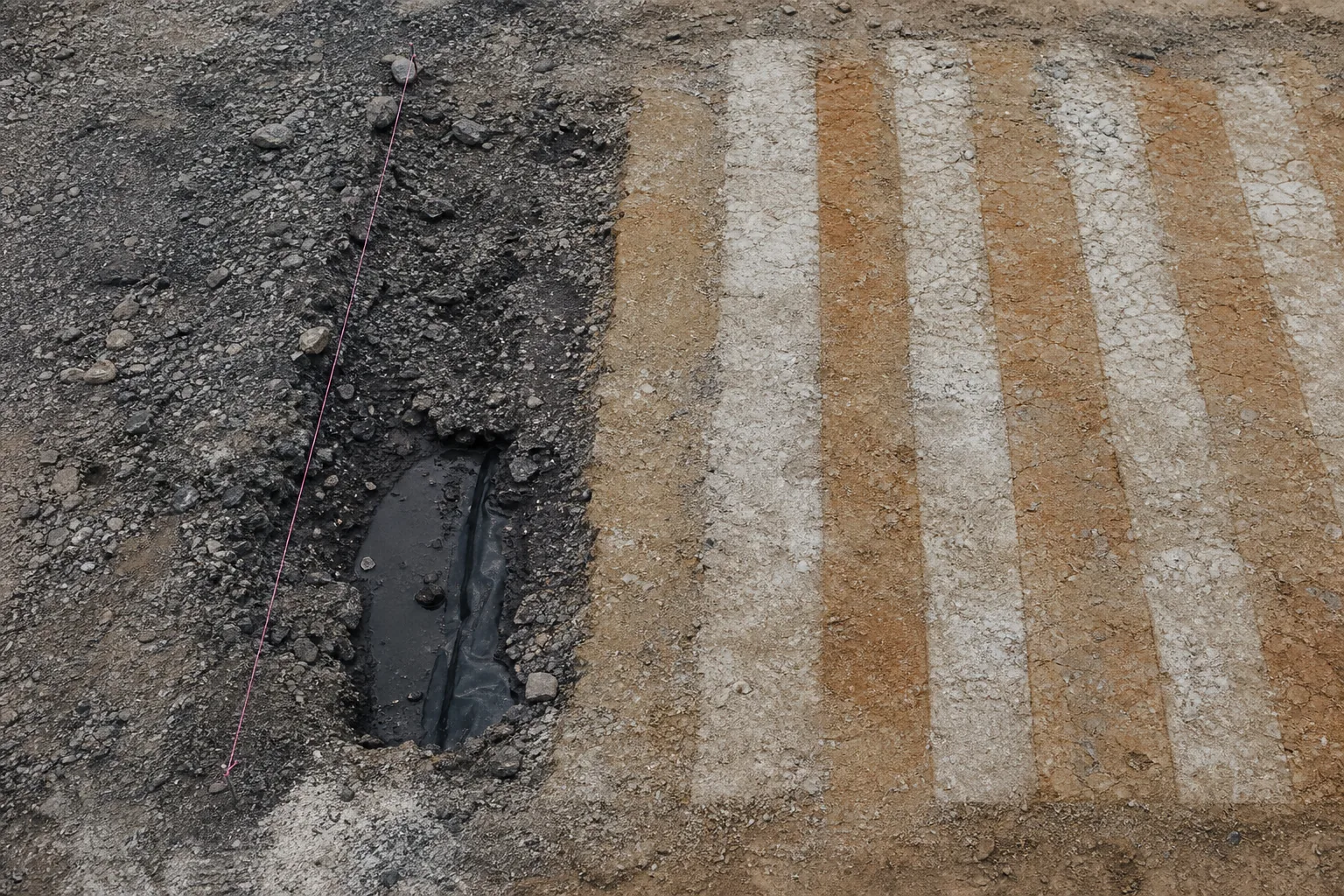
At a waste-rock pile, water can enter at the surface and leave at the toe carrying a different chemistry.
Not metaphorically.
Not as a melancholy afterlife for a mine that has stopped producing.
Sulfur-bearing minerals, neutralizing minerals, air, moisture, temperature, particle size and the geometry of placement go on meeting inside the pile.
The trucks can leave.
The reaction does not have to.
This is why closure begins while the source is still operating.
The Cluff Lake uranium mine and mill area in northern Saskatchewan supplies an address for the fact. The point is not a claim about the area’s current condition, which would need a primary record.
The point is that any former mine becomes a different kind of project once residual material can still generate water that has to be routed, characterized, controlled and explained to the people who inherit the site.
A mine is usually said to close when production ends.
It does not.
Production ends a business activity.
Closure has to turn an operating landscape into a landform, a water system, a record and an assignment of responsibility.
If any one of those is left incomplete, the project has not vanished.
It has changed disciplines.
That is where mine reclamation becomes environmental remediation.
The source survives the equipment
Reclamation starts with an inventory that sounds administrative until it reaches the ground.
Lithology.
Sulfur and neutralization potential.
Metal-leaching potential.
Particle size.
Placement history.
Seepage routes.
The amount and quality of cover material.
Those are not labels for a report.
They are the variables that decide whether water will meet a reactive surface, how long it can stay there, and where it goes afterward.
Acidic water is water below pH 7.
That is a reference point, not a verdict on treatment performance.
Metals also respond to redox chemistry, complexing ions and solids.
More importantly, a concentration without a flow does not state the environmental load.
Load is concentration multiplied by flow over time.
A small seep at high concentration and a broad seasonal flow at lower concentration do not carry the same consequence.
The prediction rests on two classes of evidence.
Static tests screen acid-generation and neutralization potential, total sulfur, inorganic carbon, mineralogy and elemental composition. Kinetic tests repeatedly wet and aerate material to expose reaction rate and changing drainage chemistry.
MEND’s comparison work examined tailings and waste-rock samples and concluded that no single test is likely to give a confident prediction of acid rock drainage.
That is less comforting than a pass-fail ratio.
It is also more useful.
A laboratory sample has a boundary.
A waste-rock pile has lifts, weathered zones, segregated materials, air paths, water paths and a construction history.
A strongly alkaline static result can mislead when the neutralizing mineral dissolves slowly, or lies apart from the sulfides.
A kinetic result constrains a rate under its test conditions.
It does not close the distance between a laboratory cycle and a heterogeneous field pile.
The question is not whether a pile is abandoned.
It is whether the pile is still a source.
This changes the operating mine long before final earthworks.
Material has to be classed: non-potentially acid generating, uncertain, potentially acid generating, metal-leaching, or construction and cover material. Those classes have to reach a block model, a blast, a stockpile or a placement record.
Otherwise a final cover is placed over an unknown inventory and called a solution.
A cover cannot correct a source that has not been characterized.
Water controls come off last
Once a mine has shaped the final landform, its water system is not construction residue. Underdrains, collection ditches, erosion controls, monitoring points and sampling access have to be installed or protected before final shaping hides the evidence.
Final swales and slopes send water to a designed route instead of leaving it to find an uncontrolled face.
The sequence has an order because it has dependencies.
Chemicals and wastes leave through authorized routes.
Utilities are de-energized.
Openings are isolated or capped.
Buildings come down only after hazardous materials are removed and services supporting water care are no longer needed.
Pumps and pipelines removed too early do not simplify closure.
They create a new pathway.
Canadian guidance sets out what a long-term wastewater treatment plan has to name: roles, system type, by-product management, maintenance, monitoring, reporting and contingencies.
The list matters because treatment is not a tank with a chemical added to it. It is a working organization of power, reagents, people, residuals, records and response.
A system that treats water and has no way to manage its residuals has moved the problem downstream.
The physical closure assessment is similarly concrete.
Guidance asks for deformation, seepage rate and quality, foundations and sidewalls, and post-closure design loads. A claimed stable landform without a measured geometry, a fixed observation point, a time period and a response is not yet a control parameter.
It is an adjective.
Vegetation offers another temptation to stop looking.
A green surface can still depend on fertilizer, conceal rilling beneath mulch, or fail to meet the intended land use. Manitoba guidance uses a 6-year point at which vegetation should be self-sufficient without fertilizer or maintenance.
That is not a universal release rule.
It is an exact warning against treating the first successful growing season as proof that a landform has become a functioning landscape.
The operating plant closes.
The water balance changes.
The duty to observe may become more important, not less.
Assurance is a model of time
The financial argument begins with a deceptively simple rule.
Security tracks outstanding liability, not historical expenditure.
It is tempting to see assurance as an accounting remainder after the engineering is complete.
It is the monetary version of the closure model.
Saskatchewan requires an approved decommissioning and reclamation plan, with an assurance-fund proposal, before a mine or mill can operate or permanently close.
The project has to name its future work before it can fully become an operating project.
That work occupies three cost horizons.
Near-term decommissioning and earthworks.
Finite post-closure monitoring and maintenance.
Then potentially indefinite work such as water collection or treatment.
Contractor rates, mobilization, materials, power, reagents, labour, residuals management, inspection, contingency and escalation all belong to the estimate, because each can persist after the mine’s revenue does not.
The longest horizon changes the meaning of a small error in prediction. A treatment duration of 20 years rather than 10, a change in power cost, or a lower investment return can dominate the provision even where earthwork quantities are well defined.
Those durations illustrate a sensitivity.
They are not a forecast for Cluff Lake or any other site. Their force is structural: a closure cost is partly a claim about a future chemical system.
Progressive reclamation can reduce the liability, but only once it is accepted as complete and has not created a new maintenance burden. Changed waste characterization, new disturbance, a longer treatment period, inflation or a revised design can increase it again.
British Columbia’s major-mine materials call for reclamation-programme updates on a five-year cycle.
That is not a Saskatchewan rule.
It demonstrates why a plan is a living estimate rather than a document written at permitting and left to age.
The money does not make the chemistry stop.
It makes the continuing work visible while there is still an operator capable of changing the design.
The mine becomes a site model
At the point where residual material, drainage and land use have to be managed together, the language changes.
The mine has a closure plan.
The former mine needs a conceptual site model: sources, migration pathways, exposure areas and receptors linked in a tested explanation.
The first remediation question is not what technology to buy.
It is whether a release is ongoing.
Saskatchewan describes four stages for risk-based management of impacted sites: notification, assessment, corrective actions, notice of site condition.
The stages can overlap during urgent work.
Stopping a discharge or isolating a drain is source control.
It is not proof of cleanup.
The conceptual site model starts as a hypothesis.
Which chemicals and media are affected.
How far, how deep and how mobile the material is.
Which pathways are complete.
Whether an intended treatment can contact the source.
A decision-quality sampling plan is not a single round of samples. It states chemical lists, locations, depth intervals, laboratory methods, detection limits, quality controls, decision rules, and the conditions that trigger step-out work.
Then the site disagrees.
Soil logs, groundwater elevations, soil gas, field instruments and laboratory results can show that the presumed source is not the source, that the water is moving somewhere else, or that the affected material is in another medium.
High-resolution tools can distinguish mass-storage zones from transport zones.
That difference can decide whether material is excavated, isolated, treated in place or managed over time.
The conceptual site model changes because the site is allowed to contradict the plan.
That is not administrative drift.
It is the discipline that keeps a former mine from being treated as a static object once its operating records have ended.
A cleanup number is an exposure decision
The next easy mistake is to make a concentration do too much work. Saskatchewan’s Environmental Quality Guidelines database holds benchmarks for more than 250 chemicals.
A benchmark can be necessary.
It is not self-executing.
A concentration becomes a cleanup driver only in a medium, at a location and depth, with a chemical form, a receptor and a plausible exposure route.
A generic residential soil criterion can be needlessly conservative for deep soil with no exposure route. A generic industrial criterion can fail where groundwater, vapour intrusion or off-site migration produces a residential pathway.
Current and anticipated land use, receptor, point of compliance, timeframe and institutional control determine what the number means.
The risk framework makes the dependency plain.
EPA guidance says cumulative post-cleanup cancer risk for actual and potential carcinogens should not exceed 1 in 10,000, while 1 in a million is normally used for general screening.
Those are United States risk-management values, not Saskatchewan cleanup criteria.
They belong here because they show why a numerical target is not portable without its exposure assumptions.
The number does not choose the remedy.
The pathway does.
Contact divides the remedies
Remediation has two broad fieldwork variants.
In-situ treatment leaves material in place.
It depends on reagent, air, heat or hydraulic contact through heterogeneous soil and groundwater. Ex-situ treatment excavates, dredges or pumps material into a controlled process, and creates material-handling and residual-disposal duties that in-situ work may avoid.
Neither description is a ranking.
An in-situ reagent can follow a permeable seam and leave adjacent silt untreated. One injected pore volume is a useful hydraulic accounting unit, not a universal dose.
Several pore volumes can move through preferential pathways without reaching the stored mass. An aggressive oxidant can instead be consumed by natural organic matter, or mobilize metals before it reaches the target.
Ex-situ work has its own honest costs.
It can provide a controlled process and direct confirmation at the base and sidewalls of an excavation, while creating dust, water, stockpile, transport, waste-acceptance and restoration decisions.
The right choice follows source geometry, treatment contact, receptors and residuals.
It does not follow the fact that one method looks more decisive from a distance.
Even monitored natural attenuation is an active claim.
Its programme has to show source and plume trends, protect receptors and compliance boundaries, and test the attenuation mechanism itself.
It is appropriate only where natural processes and flow can meet site-specific objectives in a reasonable period compared with alternatives, normally with or after active source control.
It also needs a contingency that can start when a sentinel well, a boundary condition or a concentration trend contradicts the prediction.
The groundwater evidence is part of that claim.
Hydraulic gradient is a change in head over distance.
Hydraulic conductivity is a velocity.
A water-level contour drawn from wells screened across different units can invent a flow direction that does not exist in the relevant interval.
EPA’s attenuation protocol assumes wells with at least a 2-inch inside diameter, while emphasizing the value of nested short-screened installations for identifying vertical gradients.
Wait and see is not monitored natural attenuation.
One has an endpoint and a response.
The other has neither.
The record becomes part of the remedy
Closure begins with a data-gap review, not a declaration that construction is over. The result has to be reconciled against the approved design, volumes, waste records, laboratory and field results, well logs, surveys, photographs, as-built drawings, deviations and residual contamination.
Each result is then compared with its cleanup objective, and with any pathway controlled by a cap, a building system, a monitoring programme or a land-use restriction.
In Saskatchewan’s process, a Notice of Site Condition has its own submission requirements and ministry review.
It addresses overall condition and, specifically, off-site impacts where relevant.
The notice is not a ceremonial endpoint.
It is the document through which a future owner, regulator, lender, contractor or tenant can learn what was addressed and what duty remains.
That transfer has to carry the conceptual site model, criteria, risk assessment, corrective-action and closure reports, monitoring data, as-builts, institutional-control language, cost security and access rights.
A later owner cannot maintain a vapour system, sample a monitoring point or refrain from drilling through a cap if the obligation disappears in a transaction.
The record is infrastructure.
It carries the design into a future in which the mine no longer has an operating staff to explain it.
What don’t we know?
The unanswered question is not whether reactive materials can go on mattering after production. The chemistry, the water routes and the residual controls make that possible by mechanism.
The unanswered question is duration.
How long will a particular source require collection, treatment, monitoring or land-use control? Will field-scale drainage chemistry behave as static and kinetic tests predicted?
Will an assumed cover, diversion or treatment system keep working through the climate range and the changing water balance it was designed for?
Those are not failures of closure planning.
They are the reason closure planning has to start in operations, refresh its material inventory, keep its monitoring points accessible, reserve its funding, and revise its site model when the evidence changes.
The physical end of a mine is visible.
Buildings are removed.
Roads are regraded.
A surface grows green.
The environmental end is more exacting.
It arrives only when the residual source, pathway, receptor, control and responsible party can be named together, and when the record allows the next person to keep them together.