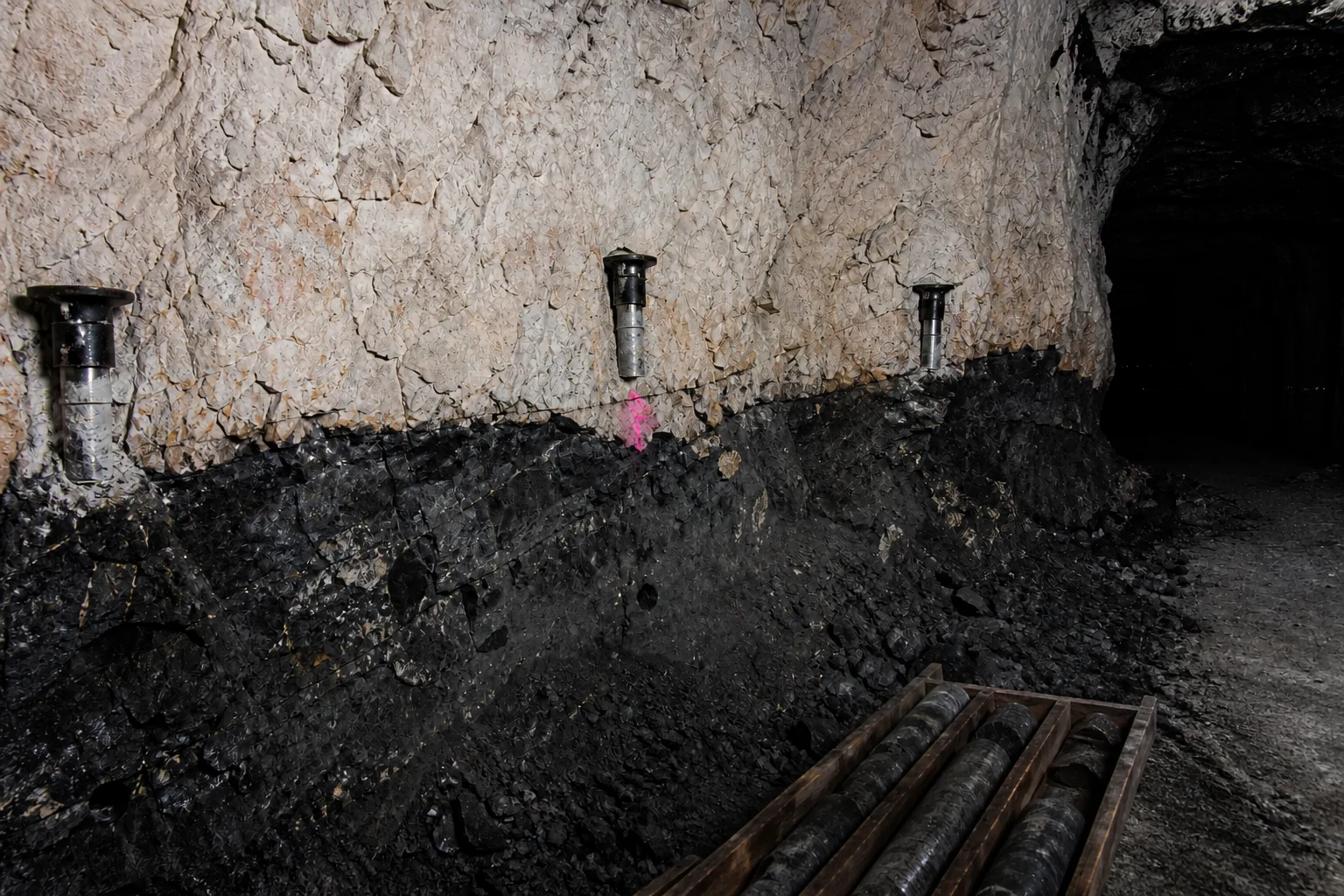
At Cigar Lake, pipes carry brine chilled to minus 40 °C through the rock around an ore panel.
Not metaphorically.
Not as a figure of speech for buried wealth, and not as a ceremonial precaution around an unusually rich metal.
The brine is circulated because the ore lies beneath water-bearing sandstone, in ground that cannot simply be opened and worked in the ordinary underground way. Cameco says the freezing takes about a year.
It is ground control.
Only after the rock and ore have reached the mine’s specified frozen condition does a production tunnel beneath the orebody receive the equipment for jet boring.
A pilot hole is drilled upward. A high-pressure water jet cuts the frozen ore. Ore and water return through the pilot hole as slurry. Workers do not enter the cavity.
The water is not there to dissolve uranium.
It cuts and carries.
Chemical extraction belongs later, at McClean Lake. Cigar Lake is not a machine imposed on a simple orebody. It is a response to an architecture: water-bearing cover above, mineralization at a geological contact, access from the footwall below.
The contact is called an unconformity.
It is also a problem of knowledge.
The boundary is an engine
An unconformity is usually introduced as missing time. Younger rock rests on substantially older rock. Deposition, erosion or both interrupted the record.
At Cigar Lake, the economically decisive surface is the junction between Athabasca sandstone and older basement. Ore lies predominantly in clay-altered sandstone. Lesser altered basement sits immediately beneath it.
That surface does more than separate ages.
The IAEA model emphasizes the conjunction of faulted basement, porous cover and redox fronts. Each part supplies a different condition. Porous sandstone can carry fluid.
Basement structures can focus or redirect it. A redox boundary can change the conditions under which uranium travels or drops out. The unconformity makes these unlike materials meet.
That is why discontinuities matter well beyond uranium. A boundary can interrupt a sequence while connecting systems that would otherwise stay apart. It concentrates flow, stress and chemical change precisely because it is not uniform rock.
But a useful boundary is not a complete story.
The tidy account says a fluid found a fault, met a redox front and made an orebody. It has the clean satisfaction of a diagram. It also risks confusing a deposit model with a recovered history.
Cigar Lake is a reference member because it makes the model visible. The IAEA Canadian model places the Cigar Lake-Key Lake trend within a resource quadrangle of more than 400,000 t of uranium metal in ores grading more than 2% U. Those are properties of a corridor within a model context.
They are not a causal explanation. They do not identify every fluid pulse, every reactivated structure or every necessary chemical boundary.
Ore is an effect.
The formation history is an inverse problem.
Divided system, divided evidence
For unconformity uranium, the disciplined record keeps separate datasets for sandstone, basement, the unconformity surface and structures that cross it. That separation is not bureaucratic tidiness. It is a refusal to let one kind of evidence impersonate another.
Sandstone records porosity, alteration and clay mineralogy. Basement records graphitic or sulfide-bearing units, alteration and structural inheritance. Faults carry orientation and reactivation indicators. Hematite, chlorite, uranium minerals and redox-sensitive elements record chemical conditions. Fluid inclusions can preserve salinity and dissolved constituents.
These observations overlap.
They are not interchangeable.
A peer-reviewed synthesis cited in the deposit record reports ore-forming fluid inclusions with up to 600 ppm U in Athabasca deposits.
The number is vivid.
It is also narrowly defined: uranium in a tiny trapped volume of fluid. It is not a uranium grade in ore.
The distinction is not pedantry. A grade has a sampled rock interval or a resource basis. A fluid inclusion is evidence about a fluid. Conflate them and a possible transport record becomes a claim about recoverable mineralization.
The same discipline applies to radiation data. Downhole geophysics must be tied to calibrated assay intervals and core recovery, particularly where high-grade mineralization can create radiometric disequilibrium. An attractive radiometric anomaly is an observation. “Unconformity-related” is a model conclusion.
One does not follow automatically from the other.
This is the first hard lesson of the contact. The geology is not one signal. It is a stack of measurements made at different supports, by different methods, bearing on different moments in the system.
A similar sandstone, another system
The nearest available mistake is the roll-front sandstone deposit. It is not a foolish mistake. Both deposit types can involve permeable sandstone and redox chemistry. Commodity alone does not distinguish them. Neither does the bare fact of uranium in a sandstone.
The architecture does.
The World Nuclear Association comparison in the corpus places Athabasca deposits below, across and immediately above the unconformity. Roll-front deposits crosscut bedding in palaeochannels. The unconformity case also calls for a basement-cover interface, basement structures and a distinctive basinal-brine pathway.
This changes what a geologist has to look for. A roll-front explanation directs attention to the sandstone and the geometry of a palaeochannel.
An unconformity explanation directs attention upward and downward at once: cover, basement, the contact, and the structures that traverse it. A core interval can be remarkable in either system. It cannot settle the comparison by itself.
Classification is not naming the closest familiar thing.
It is preserving the observations that could prove the familiar thing wrong.
This is why the Cigar Lake reference deposit is valuable without being a template. It supplies a set of questions. Is the cover porous and altered?
Is basement altered beneath the contact? Do structures cross the interface? Is there evidence for the relevant redox conditions? Do mineral, fluid and radiometric records agree?
It cannot supply the answers at another target.
Analogy narrows the search space. It does not drill the hole.
Geometry becomes a schedule
At Cigar Lake, the connection between deposit architecture and mine design is unusually literal. Water-bearing sandstone above the ore means the sequence begins with freezing rather than boring.
The mine plans panels ahead because the freeze period runs about a year. A panel that has not met its frozen criterion is not immediately mineable tonnes, whatever its mineralization may be.
This is how a geological discontinuity reaches the production plan.
The jet-boring method is non-entry. From a protected tunnel in waste rock below the frozen ore, the operation manages cavity progress, pressure, flow and slurry behaviour.
When a cavity is complete, the void is filled with concrete. The water jet and the freeze barrier are paired controls. One deliberately cuts the ore. The other constrains the ground while it happens.
Cigar Lake began commercial operation in 2015. The date does not explain the deposit. It prevents a different error: treating an operating sequence as a timeless geological illustration.
The frozen panel, the pilot hole, the slurry circuit and the mine-mill hand-off are features of a particular working system.
What leaves the cavity is not ore in the ordinary sense. It is a wet, finely ground stream, prepared underground for a pipeline and then a road.
It is not yellowcake, and it is not a final assay.
The slurry leaves the property by truck.
Chemical extraction happens elsewhere, at McClean Lake, in a mill with its own capacity and its own queue.
Road access, weather and mill availability can therefore slow mining even when a frozen panel is ready. The mine and the mill are one flow separated by a truck route.
The geology has already become logistics.
Mineralization can be available, mining can be ready, and the governing constraint can still sit downstream.
The contact concentrates value.
The industrial system distributes its consequences.
A working model, a missing history
It is tempting to treat a high-grade unconformity deposit as a solved geological riddle. The contact is visible in drill core.
Alteration can be mapped.
Structures can be logged.
Fluid inclusions can be measured. Uranium minerals and redox-sensitive elements can be identified. The mine itself is evidence that the geometry can be acted on.
None of this yields a unique reconstruction.
Several histories may create a sandstone-basement interface with structures, alteration and uranium mineralization. More than one pulse of fluid may have used a fault.
A structure may have been reactivated more than once. Redox conditions may have changed through time. Later alteration may preserve one event while obscuring another.
The word necessary is doing heavy lifting.
Faulted basement, porous cover and redox fronts can be shown to be essential features of the unconformity model.
Which combination of them was necessary at Cigar Lake, in what sequence, under what boundary conditions, is another matter. A model can be robust as a practical guide and incomplete as a history.
That is not a defect in geology. It is a property of inference from surviving effects.
Every observation has a support. A fluid inclusion records a minute fluid volume. A calibrated assay represents its sampled interval. A core log records what a drillhole encountered. A structural interpretation joins measurements across space. A resource figure belongs to a stated model context.
The task is not to flatten those supports into one persuasive narrative.
It is to hold them apart long enough to see what each can bear.
What don’t we know?
The unanswered question is not whether Cigar Lake matters. Its operating method makes the contact physically consequential every day, and the cited Cigar Lake-Key Lake corridor is credited with more than 400,000 t of uranium metal at more than 2% U.
The unanswered question is which combination of fluid pulses, structural reactivation and redox conditions was necessary at this particular orebody.
That question has a second half. How broadly can the combination be transferred to another target?
A reference deposit narrows the question. It does not answer it by association. A new target may reproduce the sandstone alteration and lack the basement signature. It may show a fault but not the right fluid record.
It may carry a radiometric anomaly without the calibrated assays and core recovery needed to interpret it. It may satisfy a model’s visible features while missing a condition that did not survive in the record.
Absence has two meanings.
The feature may not be present. Or the available drilling, exposure, analytical method or sampling support may have failed to find it.
The distinction is especially severe at a contact where parts of the relevant system lie beneath cover, beyond a hole, or in a fluid history reduced to minute inclusions.
So the honest conclusion is not that Cigar Lake explains itself. It is that the deposit makes a general fact unusually clear.
Discontinuities concentrate value before they explain it.
The frozen ground is not a metaphor. It is the present-tense consequence of a geological junction that joined porous cover, faulted basement and chemical change.
The ore is there.
The operational sequence is there. The records are there, in different forms and at different scales.
Between them is a history that geology can constrain, test and revise.
It cannot simply recover it.