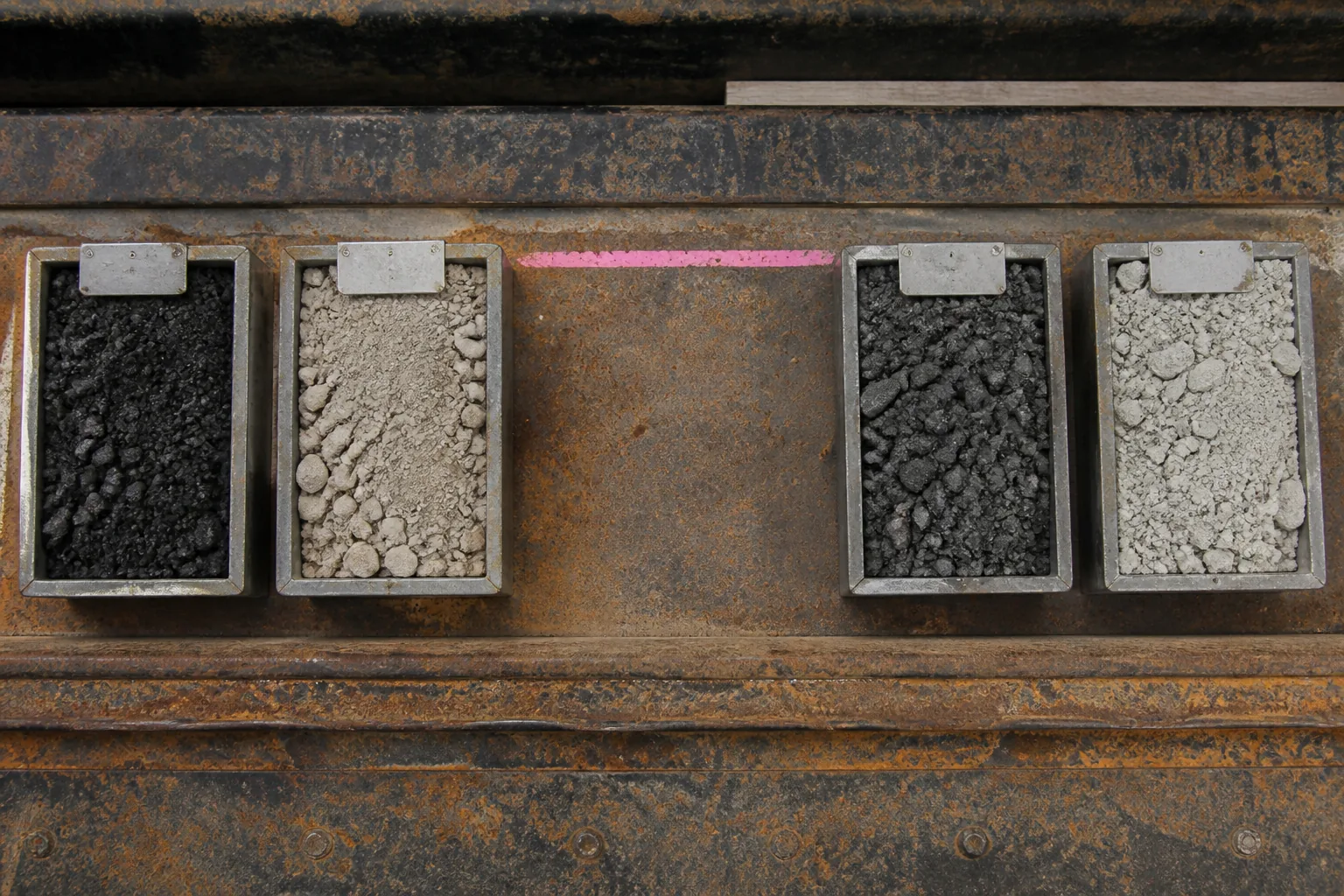
At Cigar Lake, a truck can leave the mine with four five-cubic-metre containers of uranium-bearing slurry.
Not yellowcake.
Not an orebody in miniature.
Not a finished product travelling toward a customer.
The containers hold ground ore and water that have already passed through crushing, milling, classification and thickening, and have not yet entered the chemical circuit that separates uranium from the ore.
They are a custody unit.
That distinction is easy to miss, because uranium mining is narrated from discovery to sale in one sentence.
Ore is extracted.
Ore is milled.
Yellowcake is shipped.
The verbs make the operation appear continuous.
The material is not continuous.
It changes state, location, owner or operator responsibility, and evidentiary meaning at every important hand-off.
The mine does not merely extract uranium.
It continuously decides what kind of material it has.
A panel becomes a sequence of inventories
The first temptation is to treat a high-grade ore panel as the valuable object, and every later form as administrative consequence. Cigar Lake’s reported average reserve grade at the end of 2025 was 16.33% U3O8.
That number makes the temptation understandable.
But grade is a property of a stated reserve estimate. It is not the quantity in a cavity, a slurry tank, a road container, a mill solution or a product drum.
A mine cannot reconcile its physical operation by repeatedly naming the grade of rock that is no longer in place.
The physical system at Cigar Lake holds ore still frozen in place.
Material in the cavity and collection system.
Settled coarse solids.
Fine solids in suspension.
Water that has contacted ore.
The mine recirculates process water as far as reasonably possible, and segregates or treats water that cannot return to the circuit.
Those are interlocking inventories.
They are not one inventory described with five nouns.
Each needs a destination.
The panel is also a schedule.
A panel not yet meeting its frozen condition is not immediately mineable material, whatever the model says it contains. Jet boring is a non-entry method, managed from a tunnel beneath the ore. When a cavity is complete it is filled with concrete.
Ground control therefore enters the account before product accounting does. It determines whether a stated reserve can become a controlled physical feed.
A mill plan that sees only tonnes and grade begins too late.
The truck is inside the process
Underground, the ore is recovered from sumps, reduced, classified and thickened before anything leaves the shaft.
The result is a defined but intermediate material.
Controlled, finely ground ore slurry.
Words matter here because material form matters.
The slurry moves through shaft pipelines, then 70 km by road to McClean Lake, in five-cubic-metre containers loaded four to a truck.
The number is logistical, and not only logistical.
A container lets the operation attach a transfer to an identity, a mass or volume basis, sampling or reconciliation records, and acceptance by the receiving mill.
That is where physical accounting begins to look like a claim about custody.
Solids can settle.
A batch record can detach from a container.
The receiving mill can be unable to accept material at the rate the mine produces it.
None of that changes the geology.
Each of them can break the connection between the mine’s account of material and the mill’s account of feed.
The mill is not a distant finishing plant.
It is a constraint inside the mine’s operating boundary.
Cigar Lake can have a frozen panel ready and still slow, because of road access, container availability, surface storage or mill downtime.
The first-order fact is a slurry transfer.
The second-order consequences reach mine sequencing, working inventory, tolling or allocation, revenue timing, and the evidentiary record behind all of them.
The road has turned a geological system into a coordination problem.
Chemical separation makes a different thing
McClean Lake receives the slurry by vacuum, thickens it, and holds it in pachucas before treatment.
Leaching lifts the uranium out of the solids.
Purification, precipitation, drying and packaging turn that solution into uranium ore concentrate.
Those verbs are not decorative process language.
They identify successive boundaries at which a balance can close, or fail to close.
Mined feed to slurry.
Slurry to mill feed.
Uranium in feed to uranium in solution.
Solution to concentrate.
Concentrate to stored package.
Package to declared shipment.
Residues to a controlled destination.
The informal word yellowcake is not sufficient for that job.
The IAEA notes that uranium concentrate purity can range from 45% to more than 85% uranium, depending on source and concentration process. A colour name cannot establish composition, intended use, stock, location or transfer history.
Those properties need their own record.
Capacity figures make the same point from another direction. Orano states an annual yellowcake capacity at McClean Lake well above the pounds it actually produced in 2025.
The two numbers are not interchangeable.
One is nameplate product capacity.
One is stated annual output.
Their coexistence is the point.
Capacity does not become production merely because it is installed. Production does not become delivery merely because it has been packaged.
Cameco reported 33.0 million pounds of uranium deliveries in 2025, against 9.7 million pounds of inventory at year end. An economic ledger has to reconcile contained uranium, recovery, packaged output, inventory, contract delivery and payment.
A geology model cannot perform that reconciliation by itself.
Custody keeps what a balance cannot
A material balance tells an operation whether the quantities entering and leaving a boundary make sense.
Custody answers a different question.
Who is responsible for a particular quantity, in a particular form, at a particular location.
The two questions meet at the containers.
Before dispatch, the mine needs the identity of the batch, a mass or volume basis, a sampling or reconciliation record, and receiving acceptance. At the mill, the receiving and processing record has to keep the incoming slurry distinct enough to join it to mill feed and later product accounting.
In a mine-and-mill relationship, a missing transfer record can leave a quantity physically present and administratively unplaceable.
This is not unique to uranium.
A concentrate railcar, a copper cathode bundle and a tank of lithium-bearing brine each change the evidence needed when they change form, location or custody.
Material flow alone cannot remember the condition of a seal, the basis of a sample, the identity assigned before a transfer, or the party that accepted it after one.
Accounting begins before the customer does.
The financial consequence is visible at the mine.
Cameco’s uranium operating costs divide across labour, production supplies and contracted services in roughly equal thirds. Those categories combine operating assets rather than describing Cigar Lake alone.
They show why slurry flow cannot be separated cleanly from power, reagents, labour, freight, camps, contractors and maintenance. A disrupted custody transfer is a physical interruption with a cost denominator attached.
It also has a long tail.
Canadian uranium-mine and mill licensees must hold financial guarantees for eventual decommissioning costs.
Tailings, water treatment, contaminated equipment, product storage and closure obligations do not begin when accounting ends. They are part of the system that makes output legible while it operates.
Disclosure is another boundary
The easy error is to conclude that a detailed operating record automatically becomes public securities disclosure.
It does not.
The public boundary asks a narrower question.
Is a technical claim about a material property being made to the market? Does the claim have an effective date and an evidence base? Has a qualified person accepted responsibility for the relevant work?
Mine records can become consequential without becoming filings themselves. New drilling, metallurgical results, land-tenure changes and model revisions may affect a technical conclusion. A changed slurry inventory may expose a reconciliation problem.
Neither fact, standing alone, states the securities outcome.
The issuer and its qualified persons still have to decide whether the changed information alters a material public claim.
The word material does real work there.
For several disclosure events, an independent technical report is required when total resources or reserves change by 100% or more from the most recent independent report. That is a trigger, not a universal test of importance.
A smaller change can still require explanation.
A mine operating perfectly inside its custody system can still face a disclosure question. A noisy operating variance can stay an internal reconciliation question.
The boundaries are related.
They are not identical.
The record is part of the product
At Cigar Lake and McClean Lake, the first transformation is physical.
Frozen ore becomes a water-borne slurry.
Slurry becomes leach feed.
Uranium enters solution, becomes a purified stream, precipitates as a solid concentrate, and is dried, packaged, stored and eventually declared for shipment.
Each form discards some evidence and demands another kind.
The orebody no longer supplies the mass of a container. A container does not supply the chemistry of a concentrate. A product assay does not identify the mine panel that produced its feed.
A resource table cannot certify a delivery.
A technical report cannot substitute for a custody and reconciliation record.
The systems work because they do not ask one record to do every job.
That is the general rule.
A physical transition is not merely movement through a plant. It is the moment at which material has to acquire an identity adequate to its new form and its new consequence.
Without that identity the operation can still move ore.
It cannot demonstrate what happened to it.
What don’t we know?
The corpus makes the intended controls clear.
It does not provide Cigar Lake’s reconciliation accuracy across frozen ore, cavity material, settled solids, suspended fines, containers, mill feed, concentrate and residues.
Nor does it establish the tolerance at which a difference between mine and mill records becomes an investigation, a commercial allocation issue, or a public technical-disclosure question.
That uncertainty is not a gap prose should fill with a number.
The corpus also does not determine which operational changes at either site would be material enough to require fresh disclosure. The reporting framework provides defined disclosure events and an independent-report trigger for several of them. It does not turn every changed inventory, delay or throughput constraint into a securities announcement.
There are systems that should reconcile, and public claims that should be supportable.
The first is a continuing operational discipline.
The second is a qualified disclosure decision.
They touch at the record.