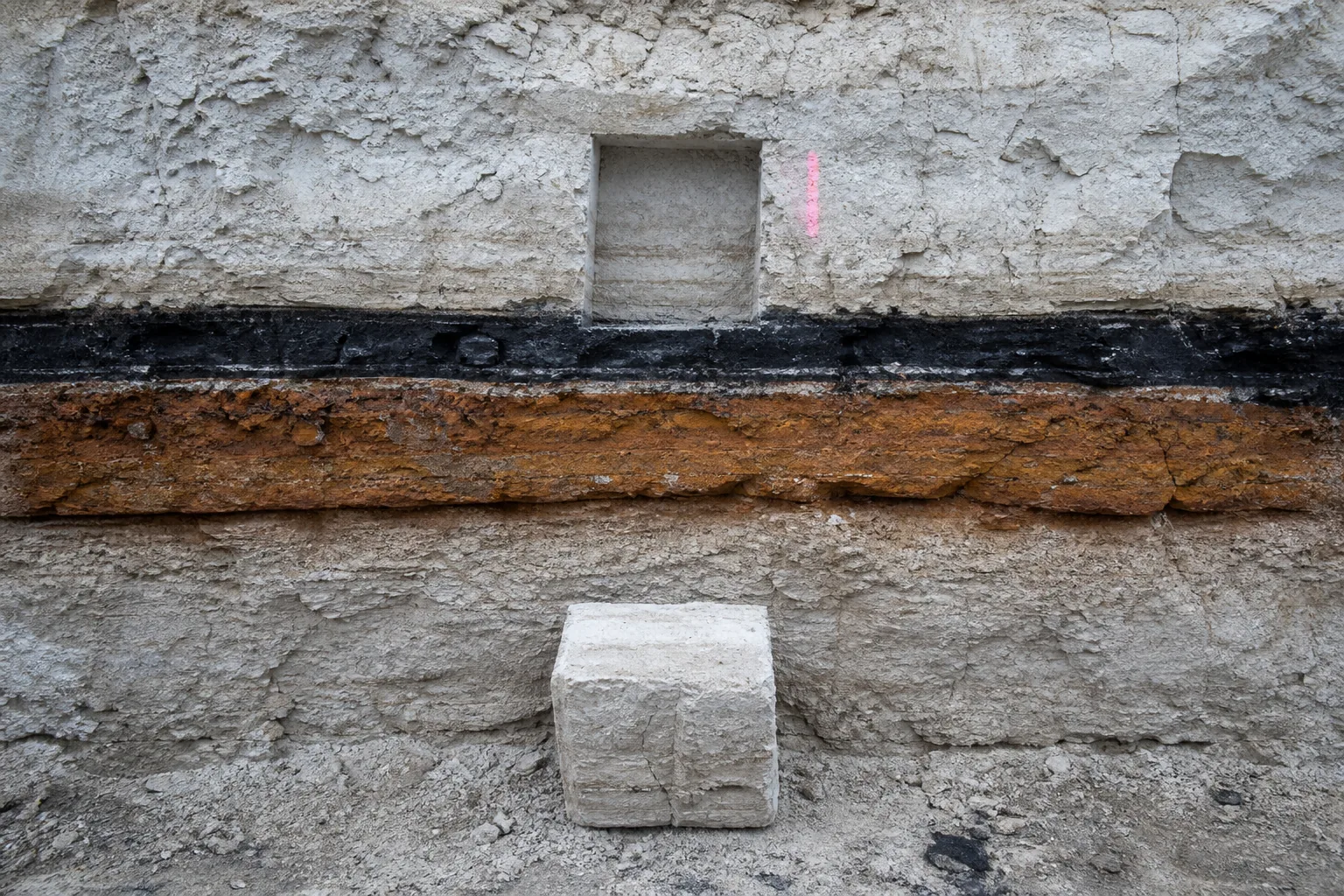
A core from the Prairie Evaporite can be crushed until it no longer looks like rock.
Not as an image of anything.
The powder is a population of tiny crystallites, turned through an X-ray beam. At particular angles, planes inside those crystallites send intensity back to the detector.
The instrument records peaks.
It does not record mineral names.
That distinction is the beginning of an honest core description. A peak position constrains a plane spacing. A pattern of positions, relative intensities and absent reflections can strongly constrain a crystalline phase.
A mineral name belongs later. After structure, composition, formal rank and sample context have been kept distinct long enough to do their separate work.
Diffraction is usually called a fingerprint.
It is more useful than that, and less final.
It is an elimination procedure. Each measured feature makes some structures harder to maintain. The identification becomes strong not when one familiar pattern looks nearby, but when credible neighbours have been ruled out by independent evidence.
A peak is a spacing first
Powder diffraction begins with geometry. A powdered specimen presents many randomly oriented crystallites. As the instrument scans angle, each eligible plane spacing can yield a peak position. The pattern can be compared with calculated or measured references, because periodic structures do not choose their spacings freely.
But position is not identity.
The relation between spacing and cell dimension depends on the crystal system. A cubic shortcut fails as soon as the third cell edge differs from the first two.
A small worked case makes the point. A tetragonal cell with edges of 501 and 451 pm gives a particular plane a spacing of 279 pm. Those numbers are not a mineral identification. They show why an observed position is evidence about both a plane and a metric.
Several indexed positions together constrain a cell far more powerfully than one prominent peak ever can.
The notation has its own discipline. Parentheses identify one plane orientation. Braces make a symmetry statement about a family of them. In lower symmetry, index permutations that look interchangeable may not be equivalent at all.
The detector has not seen a substance.
It has encountered a lattice constraint.
The missing peaks are the measurement
Some of the most useful observations are not peaks. They are reflections that symmetry forbids.
In a body-centred lattice, corner and centre contributions cancel for certain index sums. Those reflections are systematically absent. In a face-centred lattice, only all-even or all-odd indices can appear. A screw axis can suppress a sequence along an axis. A glide plane can suppress particular zones.
These are reflection conditions.
They are not a bad scan. They do not mean that a geometric plane contains no atoms.
They are the visible consequence of translational symmetry in the structure factor.
That makes absence diagnostic.
A pattern indexed as face-centred while carrying strong mixed-parity reflections may point to an incorrect cell, multiple phases, twinning, contamination or an indexing error.
The apparent failure is an instruction to revisit the model.
A space group is not a decorative suffix on a mineral record. It is an exclusion rule applied to what the instrument should and should not see.
There are seven crystal systems, fourteen Bravais lattices and 230 space groups. That is not a list of 230 answers. It is a grammar that removes impossible ones. A crystal system constrains a model. It does not determine composition, atomic basis, defects, density or mineral name.
The missing peak is evidence.
It is not silence.
A reference pattern has conditions
A published reference pattern names its radiation, its angular range, its step size and its counting time. Those are not universal instructions for a Prairie Evaporite sample.
They make a different point. An identification result has conditions, and the conditions are part of its meaning.
Radiation, angular range, step or counting time, specimen preparation, angle calibration and profile response belong with the pattern. Standard reference materials do different jobs: one for quantitative phase analysis, others for line position and line shape. A number lifted from one of them is not a general requirement for every core sample.
Reference databases make the comparison tractable, not automatic. A structure database can supply candidate cell dimensions, a space group, atom positions and calculated powder data across hundreds of thousands of entries.
It cannot make a strained, textured, mixed, disordered, transformed or hydrated specimen become the reference structure.
This is where a core description turns overconfident by being too tidy. A pattern may contain peak overlap. Preferred orientation can change relative intensities. Absorption, background and an amorphous contribution can affect a mixture model. A reference phase may simply not be in the database.
Whole-pattern refinement estimates phase amounts only after those matters have been addressed.
Matched a card is not an account of that work.
A defensible account keeps the discriminating reflections and the unassigned peaks.
A composite can look ordinary
Twinning makes the problem sharper. A twinned crystal contains differently oriented domains.
Where the overlap is exact, one measured reflection contains intensity from twin-related reflections, weighted by their domain fractions.
The reciprocal lattices coincide.
The spot looks entirely ordinary.
The measurement is composite.
For a two-domain model, the smaller-domain fraction runs between zero and one half. At exactly one half the simple detwinning equations are indeterminate, because equal domain contributions cannot be uniquely separated from their sums.
Below that limit, a candidate structure can incorporate the twin law and refine its fraction against composite intensities. A minor domain fraction of a fifth means roughly a fifth of the illuminated diffracting volume contributes twin-related intensity under that model. It does not mean a fifth of the atoms are an impurity.
Non-merohedral twins leave a different record. Some reflections are unoverlapped, some overlap exactly, some overlap partially. More than one orientation matrix is needed for indexing and integration. The unoverlapped subset can still carry direct information about an individual domain.
This is why a good fit after adding a twin parameter is not enough. IUCr guidance says twinning should be invoked on independent evidence, not merely because an agreement statistic improved.
A model that absorbs every inconvenience becomes less truthful while looking more precise.
There is a related limit in ordinary diffraction symmetry. Friedel’s law makes the diffraction pattern centrosymmetric even where the crystal structure is not. The pattern then falls into one of 11 Laue classes, while structures occupy 32 point groups.
Pattern symmetry is not identical to structural point group. A Laue class is not a space group.
The experiment reports what it can observe. That is a narrower thing than the specimen is.
A structure does not choose its rank
Suppose the diffraction evidence supports a crystalline phase in a Prairie Evaporite core. The next temptation is to turn the phase immediately into a mineral name, then treat the name as a complete description.
That is another category error.
The Nickel-Strunz scheme sorts minerals into chemical-structural classes, from native elements through sulfides, halides, oxides, carbonates, sulfates, phosphates and silicates to organic compounds. A class is a high-level address. It is not an identification key, and it is not a synonym for group.
The formal hierarchy is separate again. A mineral species is the unit normally approved or revised. A group gathers species with related composition and structure. A supergroup gathers related groups.
Reference schemes organize.
A commission governs names.
Neither converts evaporite, ore mineral or a commodity label into a formal class. A context label tells a reader where or why a material matters. It does not settle what the material is.
Even a formula is not enough. Anion families make useful first branches: carbonates, sulfates, phosphates, silicates. A formula records proportions, and not the connectivity of silicate tetrahedra.
Silicates arrange as isolated tetrahedra, paired tetrahedra, rings, chains, sheets and frameworks.
Structure narrows chemistry.
Chemistry narrows structure.
Neither should impersonate the other.
The mineral name is a conclusion about a controlled set of distinctions.
It is not the first label available.
The record has to keep the supports apart
A defensible classification record begins with the accepted species name, its formal status, its class, its group or supergroup, and the scheme and version used for any numerical code. A fuller identity record adds formula, crystal system and validity.
The repetition is not bureaucracy. It stops a species from becoming a group, a class from becoming a commodity, and a code from being presented as a name.
For a new or revised species, the nomenclature commission expects an evidence set covering occurrence, appearance, physical and optical properties, chemical data, powder-diffraction data, unit-cell parameters, space group, crystal structure and relations to other species.
A core description need not reproduce all of that. It must not imply that one part of it performed the work of the others.
Composition needs the same separation. An ideal formula and a measured analysis on its stated basis are two records. Weight-percent oxide, elemental weight percent, atoms per formula unit and trace-element concentration are not interchangeable.
Substitution, vacancies, hydration, impurities, inclusions and analytical method can make a measured specimen differ from an ideal formula without making either record false.
Structural values add another scale. Unit-cell edges are reported in Ångströms, angles in degrees. Those values can distinguish phases that colour or hardness cannot. They are not a casual field test.
The Mohs scale runs from talc at 1 to diamond at 10, and reports scratch resistance rather than toughness or general durability.
Every datum has a support. A pattern belongs to its preparation and instrument conditions. An analysis belongs to its laboratory, method, detection limit, date and sample identifier. An occurrence record needs host material, formation setting, associated minerals and locality. A species name carries a formal status that can change as approvals, redefinitions and discreditations proceed.
The evidence does not become stronger when its provenance disappears.
What don’t we know?
No site-specific diffraction result is supplied for Prairie Evaporite core and cuttings here. There is therefore no defensible claim that a named phase occurs at a named depth, in a named sample, at a stated abundance.
That absence matters, because the hard part of identification is rarely generating a plausible candidate.
It is deciding which alternatives survived the measurement.
Peak overlap can make two phases share positions. Preferred orientation can alter the intensities that would otherwise discriminate them. Mixed phases can produce a pattern no single reference explains. Compositional variation can move a material away from an ideal reference. Twinning can superpose intensities from domains and make an individual structural interpretation unstable.
Weak allowed reflections can fall below detection, while symmetry-forbidden ones fail to appear for an entirely different reason.
The word identified covers several strengths of claim.
Consistent with can be the correct result for a pattern under stated conditions. Species assignment supported by diffraction and independent chemistry says more. Accepted species name, current status, structure and occurrence established for this sample says more again, and requires the record to match.
The useful conclusion is not that diffraction fails to name a mineral. It is that diffraction makes the naming process testable.
The powder from a Saskatchewan core can constrain a periodic structure with remarkable force.
Its peaks locate spacings.
Its absences restrict symmetry.
Its intensities test a model. Its mismatches keep alternatives alive.
Chemical analysis, classification and provenance then decide what kind of mineral statement those constraints can bear.
One familiar pattern is a beginning.
An identification is what remains after its neighbours have lost their case.