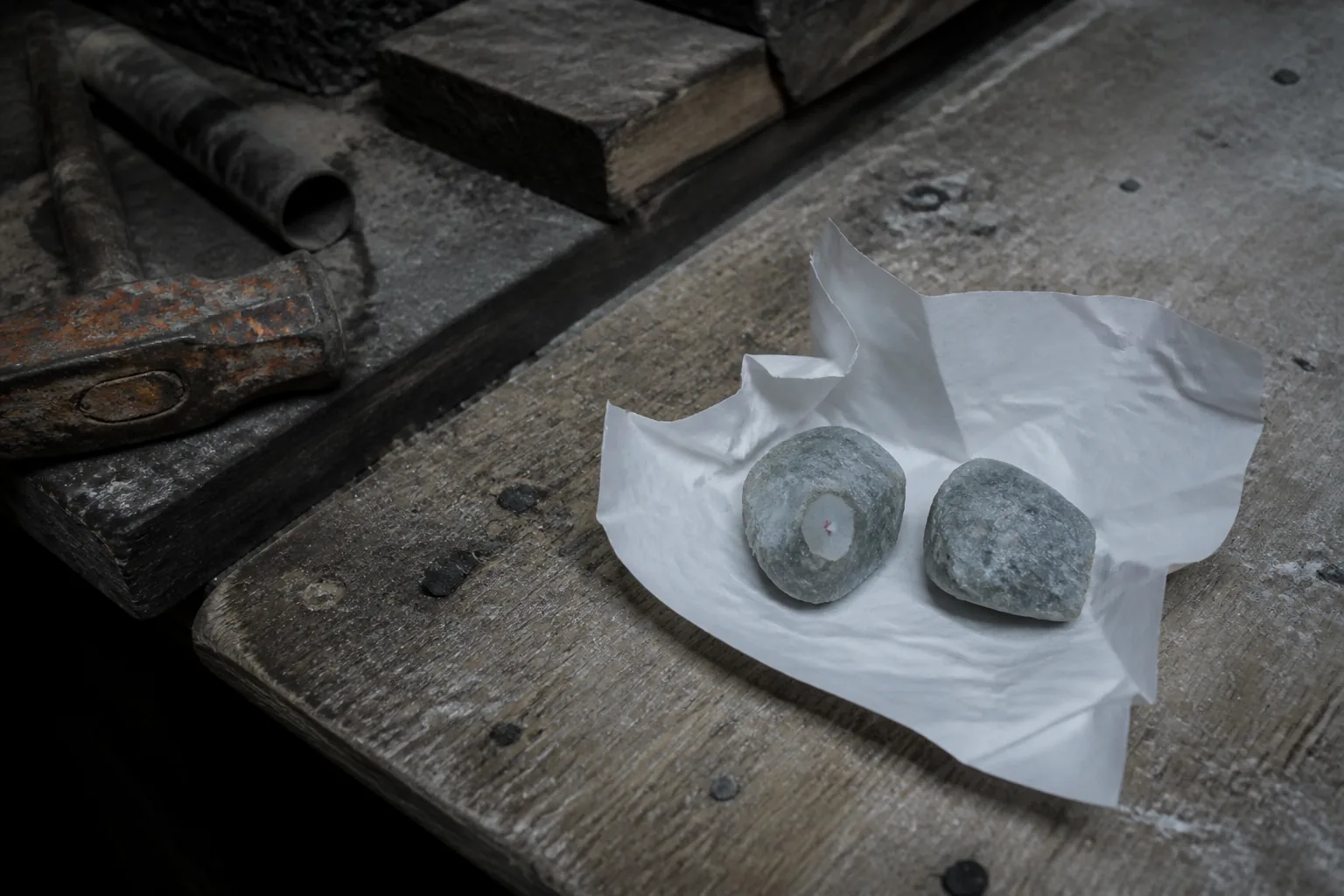
At the Fort à la Corne diamond exploration field in central Saskatchewan, a stone can be held in tweezers beneath a 10× loupe and look blue.
That is not an origin.
It is not even necessarily an account of the colour.
The loupe can show inclusions, surface features and perhaps a construction clue. It can make the eye work harder. It cannot decide by observation alone whether the blue is natural, treated, laboratory-grown, associated with a particular trace element, or diagnostic of the place where the stone was mined.
The treatment history may be invisible at that scale.
This is not colour revealing origin.
It is an incomplete measurement.
The distinction matters because gemstone language becomes more consequential as it moves away from what can be seen. Shape, cutting style, transparency, general colour and weight are description. Diamond clarity is a calibrated observation made at a stated magnification.
A statement that a natural gem came from a particular country or region is something else. It is an opinion about history, formed by comparing an object in hand with a reference population that stands in for a geological system nobody can put on the bench.
A gem is said to have an appearance and an origin.
It has an appearance.
Origin is harder.
The object has to survive the claim
The first discipline is physical identity. A GIA identification-and-origin report can carry a unique report number, an examination date, shape, cutting style, transparency, colour, species, variety, an origin opinion and treatments.
Those fields do not all do the same work.
Length, width and depth in millimetres record a shape in space.
Carat weight records mass.
A one-carat emerald can look larger than a one-carat diamond, because the species do not have the same density.
A mounted jewellery item has a total weight, and that is not automatically the stone’s weight. A report number points to an examination at a particular time. It is not a physical feature of the gem.
This is why a record needs a photograph, any engraving or laser inscription, the condition of the stone, and an account of whether it was loose or mounted.
Recutting, repolishing, remounting, material repair, or separation from its report can break the physical linkage. A seller’s stock number is inventory control. It is not evidence unless the chain between the label, the document and the object has been kept.
The point is almost bureaucratically plain.
Before a laboratory can infer a history, it has to know which thing it examined.
Appearance is a protocol
Colour looks immediate, because it reaches the eye before the explanation does. Even colour requires a protocol.
GIA makes coloured-stone colour calls face-up, using Munsell colour chips and a standard light box, with master stones for particular calls. The record can preserve a plain-language description beside hue, tone and saturation. A photograph cannot stabilize those fields against illumination, camera response and display changes.
A blue description is the result of a specified view. It is not a theory of cause.
Diamond colour has its own reporting boundary. Natural colourless diamond is described on the D-to-Z scale. Saturated fancy-colour diamond is described through hue, tone and saturation instead.
So the same word blue can name natural blue, treated blue, or laboratory-grown blue diamond. The eye sees one attribute. The record has to keep three member states apart.
Clarity draws the boundary in another way. Under magnification, a grading system considers an inclusion or blemish by size, nature, position, colour or relief, and number. That is a defined observation framework, not a portable measure of every gem’s condition.
Emerald is the useful refusal. Eye-visible inclusions are typical even in high-quality material, although inclusions that reduce transparency can strongly affect value.
The grade is not the stone.
Nor is a gem’s visible quality a geological fingerprint.
Cut makes the problem more severe, because it changes what the eye receives. Outline, faceting pattern, proportions, polish, symmetry, windows, abrasion and recut evidence belong in separate fields. Polish and symmetry describe execution, not species, colour or origin.
A cabochon and a faceted stone can show the same material differently. Optical phenomena such as asterism, chatoyancy, play-of-colour, colour change and adularescence depend on light and orientation.
An effect is not a locality.
Treatment carries a different burden
The most dangerous compression is to let a colour description do two jobs at once.
A blue stone can be blue. It can also have been heated, irradiated, coated, dyed, diffused, fracture-filled or clarity enhanced. Coloured-stone treatment work groups into broad classes covering each of those routes.
These are not grades of the same property.
Treatment disclosure has its own layers.
What was observed.
The conclusion.
The test basis.
The wording supplied to a reader. The layers keep a microscope observation from becoming an assertion it cannot bear.
Under long-wave ultraviolet light, certain emerald clarity fillers can fluoresce yellow to blue. Chalky short-wave fluorescence is noted as a possible clue to heat treatment in blue sapphire. Both are reasons to test further. Neither observation is the treatment verdict.
The phrase no indications has a narrow meaning.
It means a named laboratory, on a stated report date, detected no evidence within the scope of that service. It does not mean nothing was ever done to the stone.
That is not a weakness in the report. It is an honest boundary around the detection system.
Natural against laboratory-grown is another such boundary. Infrared, fluorescence, Raman and ultraviolet-visible spectroscopy, and further methods where needed, separate natural material from laboratory-grown material and detect treatments.
Colourless to near-colourless laboratory-grown diamonds share many physical and gemmological properties with natural diamonds. Type II material is rare among natural diamonds and characteristic of colourless laboratory-grown stones, which makes type a useful pointer.
That is context, not a retail test.
A material can be suggestive without being decisive. The difference is where reporting begins.
Origin asks a mineral to keep a geography
Geographic origin begins after description, not inside it.
A laboratory compares inclusions, growth features, trace elements and spectral patterns with material whose origin is already known. The task is not to recognize a colour. It is to ask whether the combined record fits one reference population better than the plausible alternatives.
This is why provenance and origin must not be merged. Provenance can include an invoice, a mine parcel, a cutting history and previous reports. It is a chain of custody.
Origin is a laboratory opinion about where a natural gem was mined. A documented parcel can supply a strong history of transfer without demonstrating geological origin. A persuasive laboratory opinion can be reached without a complete commercial chain.
Laser-ablation mass spectrometry can use a pit roughly 50 μm wide and deep. It is minimally destructive and invisible without magnification. The point of such a pit is not theatrical precision. It is to obtain composition information the eye cannot supply, then compare it with known-origin material.
Even a trace-element result is not a coordinate.
The relevant chemical signature may overlap with more than one source. Inclusions may be absent, altered, obscured by cutting, or simply not diagnostic. Growth features can be difficult to read.
Reference collections are finite.
So the correct conclusion can be inconclusive. GIA reports origin only where it considers origin determinable, and CIBJO states that place of origin is a matter of opinion rather than a quality level.
The word opinion is not an evasion.
It names the form of the claim.
A mineral name carries a range
Mineralogy makes the same lesson less forgiving. A mineral name is often not a fixed composition with a fixed density, refractive index or colour.
Solid solution permits substitution within a mineral series, changing mean atomic mass, bond length and local polarizability. In the plagioclase and alkali-feldspar series, specific gravity ranges from about 2.55 to 2.76 g/cm³.
That range is a material consequence of composition and structure.
It is not a name tag.
An initially uniform solid solution can also separate on cooling into two compositions through exsolution. A microanalysis crossing those lamellae returns an average that describes neither phase. The numerical result is not false. It is answering a larger question than the identification required.
Polymorphism imposes a stricter warning. The same formula can have a different atomic arrangement, density, optical response, mechanical behaviour and stability.
In a controlled calcite-marble experiment at high pressure and temperature, aragonite conversion approached completion in a matter of weeks. The result establishes a kinetic fact under those laboratory conditions. It does not reconstruct the history of every natural aragonite-bearing rock.
History is not stored in a single property.
It is distributed among phase, composition, texture, and the conditions under which each was preserved.
Independent methods narrow the inference
The strongest gem identification is not a large pile of observations. It is a set of methods that can fail differently.
Optical work classifies a transparent grain as isotropic, uniaxial or biaxial, and constrains refractive index, optic sign, birefringence, relief, extinction and absorption. Published birefringence bands run from strong through very strong to extreme.
Those bands can narrow candidates, locate zoning and show alteration. They cannot settle a composition when ranges overlap, or when a grain is poorly accessible.
Microanalysis has the opposite advantage. It can measure a discrete grain or zone and detect substitution. Elemental composition may still fail to distinguish polymorphs, or to resolve a mixed interaction volume.
Powder diffraction supplies a structural pattern, and works well for fine-grained minerals, mixtures and intergrowths. The powder is a bulked result. It does not keep the original spatial arrangement.
Each method takes something and gives something up.
The useful result is their complementarity. Optical microscopy supplies location and texture.
Chemistry supplies composition.
Diffraction supplies structure.
A robust identification checks them against physical observations and against one another. Agreement strengthens a phase call. Disagreement can disclose zoning, alteration, poor preparation, a mixed sample, or an incomplete reference library.
That is also the right model for origin work. A trace-element pattern without inclusions is not the same record as inclusions without a spectral match. A colour observation is not an analysis of growth history.
A report can state its result cleanly only after its supporting measurements have been kept distinct long enough to test whether they converge.
What don’t we know?
Fort à la Corne provides the place where the question becomes concrete.
The question travels.
What, in a particular blue gem, distinguishes natural colour from a treatment history? Which inclusions, trace elements, growth features and spectral patterns distinguish one geographic source from the plausible alternatives? What could a further method disprove?
The corpus does not answer those field-specific questions. It supplies no Fort à la Corne diamond signature, no reference collection, no treatment result and no origin determination. It should not be made to imply them.
There are several legitimate endings to an examination. A laboratory can identify the species. It can describe colour under a protocol. It can record dimensions and mass.
It can report a clarity grade on its stated system. It can disclose evidence of treatment, or no indications within its service. It can find the origin determinable. Or it can find it inconclusive.
Those are not rungs on one ladder of quality.
They are answers to different questions.
The temptation is to make the most marketable word carry all of them.
Blue becomes natural.
Natural becomes untreated.
Untreated becomes local.
Local becomes a particular mine.
The sentence grows smoother as the evidence disappears.
The disciplined record moves in the other direction.
It says what was seen. It says what was measured. It says what was inferred. It says who made the inference and under what conditions. It leaves the history open where the surviving mineral record cannot close it.
That is not caution added after identification.
It is identification.