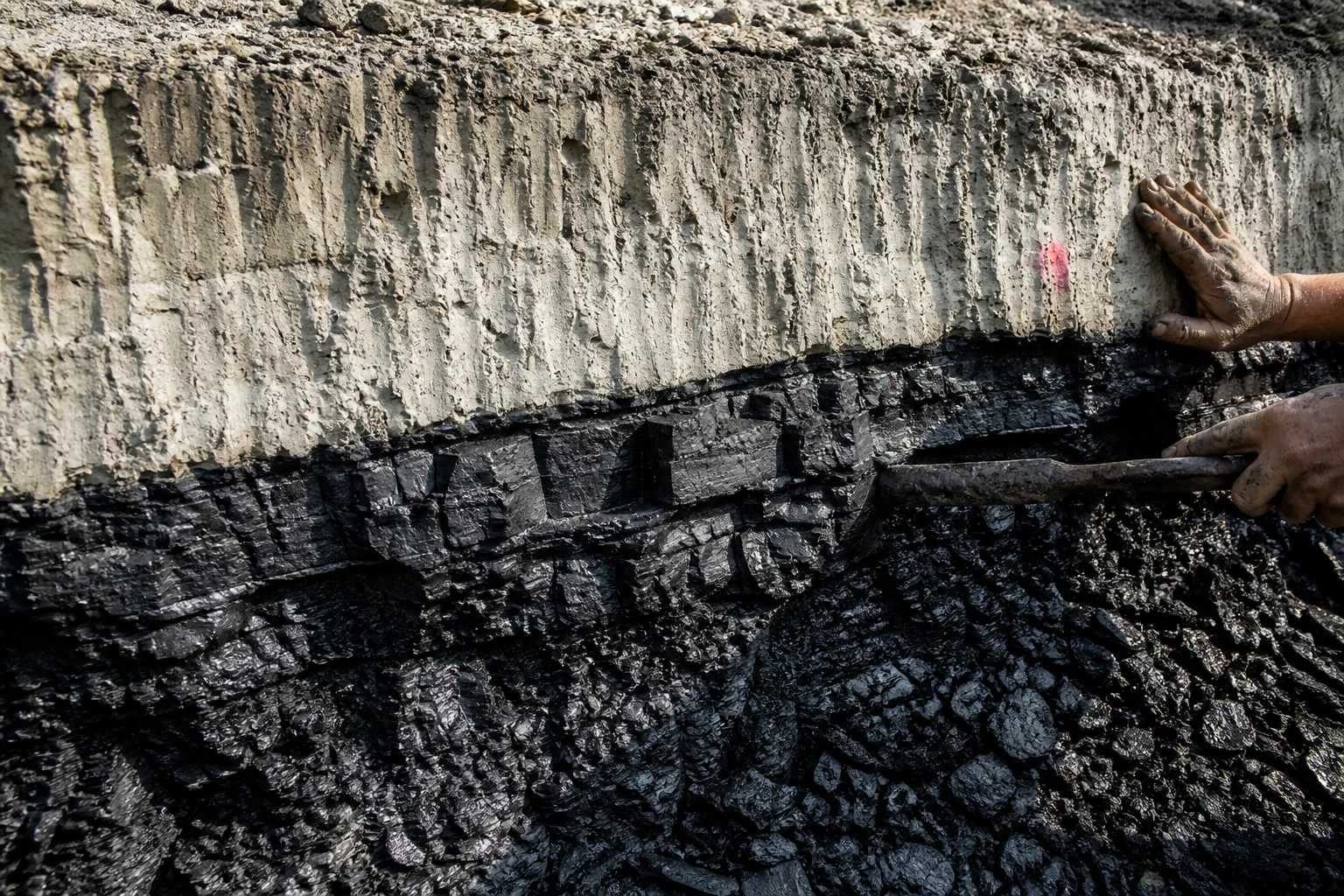
In the Estevan coal-mining district, the seam does not disappear when a buyer stops needing what it was meant to provide.
It stays black or brown in the ground.
It keeps its moisture, ash, sulfur, carbon content, thickness and access geometry.
So does the machinery built to reach it.
A shovel, a dragline, a conveyor or a truck does not become incapable of touching coal because a market has changed.
The first temptation is to call this depletion.
It is not.
It is a discontinuity between physical life and economic life.
A coal deposit has one sequence of limits.
Geology, ground conditions, mine design, equipment condition, the ability to move material.
Its intended market has another.
Power-station demand, steelmaking routes, competing fuels, replacement capacity, industrial output, policy.
Those sequences can end together.
They do not have to.
When the market ends first, a mine plan becomes a closure sequence.
Rank decides which market can vanish
Coal is treated as one commodity with a single future.
Its classifications do not permit that simplicity.
Rank is an account of coalification and material properties. Lignite sits near the bottom, with a typical carbon content of 25 to 35%.
Anthracite sits at the top, above 86%.
Subbituminous and bituminous coal fill the range between.
Those categories do not sort coal into useful and useless, or modern and obsolete.
Lignite is commonly moisture-rich and low in energy density. Its long-distance transport can be disproportionately consequential, because a shipment carries water and mineral matter as well as combustible material.
That is why lignite is often burned at a mine-mouth plant or processed locally. The market it serves is entangled with a particular geography of power generation and transport.
Bituminous coal gives the opposite warning.
It is a range wide enough that the word alone says little about ash, sulfur, washability, fluidity or coke strength.
Some bituminous coal is thermal fuel.
Some is suitable coking material.
A coking coal has to soften, fuse and resolidify into coke that can support burden and act as fuel and reductant in a blast furnace.
Black rock is not a product specification.
Reporting boundaries make the point exact.
In European energy statistics, lignite falls below 20,000 kJ/kg gross calorific value on an ash-free, moist basis. Hard coal sits above that line, with a minimum vitrinite reflectance as well.
Those are reporting definitions, not a mine plan.
They show why a demand shock does not act on coal in the abstract. It acts on a material routed toward a particular combustion system, coke battery, rail destination or industrial process.
Thermal coal serves steam, electricity and process heat.
Metallurgical coal serves steelmaking.
Each is a large demand stream.
Neither is the other.
A mine cannot solve the disappearance of a thermal buyer by discovering that its product is black. It has to satisfy a different transformation requirement, a different quality envelope and a different industrial system.
Often it cannot.
Coal has false continuities at its edges too.
Peat is a precursor in coalification, not one of the standard ranks. Coke is a manufactured carbon product made by carbonizing coal without air, not a rank of the material that entered the oven. Coalbed methane and mine gas are gaseous hydrocarbons associated with seams, not coal tonnage under another name.
The same care applies after preparation and combustion.
Middlings, refuse and slurry are operational fractions with their own material and handling properties.
Ash is mineral residue after burning.
Each can persist in the physical system while the saleable coal market contracts. None of them substitutes for the product whose demand has fallen.
Names can conceal a changed material flow.
A market exit does not alter the seam
The material boundary stays geological.
The demand boundary is temporal and geographical.
The IEA puts total coal demand near 8.85 billion tonnes in 2025 and forecasts a gradual decline through the rest of the decade, with different regional paths inside that total.
Weather, hydropower, gas prices, renewable additions, industrial output and policy can all move annual consumption.
Some movements are cyclical.
Others are structural.
That distinction is not semantic.
A wet year, a fuel-price movement or an outage can change a power station’s burn without settling its long-term role. A long-run change in capacity, technology or industrial process can remove the reason a mine was designed at all.
Neither event changes carbon content by one percentage point.
Coal can leave an energy system without ceasing to be coal.
That is the hard fact at Estevan, and in any district built around a specific use. The question is not whether the seam is still present.
It is whether the connected system can still turn that seam into a sale, on terms that support the next cut, shift, repair, haul and obligation.
Mineable is a technical word.
Economic is a relationship.
The machine is a set of dependencies
A mine is said to slow because it has less work.
The machine has more parts than that.
Mechanization joins extraction to power, haulage, crushing, maintenance, control and dispatch.
A cutter needs a route for material.
That route needs energy and availability.
Higher output needs every downstream component to keep pace.
The bottleneck is the stage whose capacity limits the connected flow. It does not necessarily sit at the coal face.
The historical record is unusually clear on this.
American longwall installations rose from 6 to 50 across a single decade in the 1960s and 1970s, and annual production from those systems rose by an order of magnitude.
Those figures do not say every coal district follows the same path.
They establish the mechanism.
Higher throughput is not a bigger pick.
It is a coordinated technical system.
When demand declines, that system does not merely make fewer tonnes. Its components are reassigned, run below capacity, maintained for a possible restart, idled, stripped for parts, sold, or made safe.
A failed conveyor can stop a mine that has a market. A market loss can leave a functioning conveyor with no job.
Direct hand loading falls as mechanization rises, and technicians, electricians, mechanics, surveyors, control-room staff and contractors become more important.
Closure therefore reaches occupations unevenly.
A workface can stop before a maintenance requirement does. A repair shop can stay busy while output falls. A supplier can lose orders before the mine has formally closed.
Output is the visible end of the system.
It is not the system.
Lower grade makes scale a condition
Mining history carries a second warning.
As accessible richer material is depleted, or as economics change, lower-grade material becomes workable through lower unit costs, improved recoveries, changed cut-offs, co-products and larger, more reliable throughput.
Long-run studies of metal mining find declining ore grades alongside strong, cyclical production growth. That is not coal evidence converted into a rule.
It is a mass-balance lesson from mining history.
Once lower grade is accepted, more material normally has to pass through the physical system per unit of contained commodity.
The response is not simply more digging.
It can mean more installed power, water, transport, waste handling, processing capacity and maintenance.
The mine becomes larger in material terms in order to keep output steady.
The IEA reports rising capital intensity for expanding existing copper projects, alongside lower average grades and greater project complexity.
Again, that is not a coal figure.
It shows the shape of the problem.
Grade decline becomes an infrastructure story before it becomes a number on a cross-section.
Coal mines face a related inversion.
A system built to keep marginal material economic through scale becomes exposed when the market contracts. The equipment, workforce and fixed infrastructure that made the tonnes possible also make a rapid reduction difficult.
Capacity does not vanish at the rate demand does.
The physical system remembers the larger plan.
Work does not end where production ends
Mining gathers people around a fixed asset and divides them by shift, occupation, contractor, skill and responsibility.
Mechanization changes the division.
It does not abolish it.
That is why closure cannot be reduced to a headcount or a final production date. Maintenance intervals, staffing, training, inspections, traffic management, lockout and equipment condition stay operational questions while equipment is active, idle, or being removed.
The mine’s dependence on a workforce does not end at one instant.
It changes form.
Safety history makes the point without offering a simple moral. American coal fatality rates fell sharply across the 1970s. Regulators attribute the long-run improvement to research, technology, training, regulation and evolving cooperation among management, labour and government.
No single lever accounts for the change.
Nor did the hazards disappear.
NIOSH reports that small rock pieces falling between bolts injure 400 to 500 coal-mine workers a year, and that roof, rib and face falls accounted for nearly 40% of underground fatalities across a recent decade. Machinery and powered haulage account for a majority of mining fatalities in more recent counts.
Those are not figures for the Estevan district.
They are a warning against treating a changing mine as an empty mine.
Hazard control shifts with the remaining work.
Moving equipment.
Isolating energy.
Managing ground.
Maintaining access.
Deciding which systems have to keep functioning after extraction no longer does.
Closure changes the hazard system.
It does not remove the need for one.
Reclamation answers to the asset
The final consequence is usually described too late.
Reclamation, water management, landform stability, equipment disposition, records, monitoring and financial provision belong to the mine’s physical life. They are not undone by a decline in demand.
The timing problem is the whole problem.
Revenue can fall before the technical and social work attached to the asset has been completed.
This is why a closure sequence is not a single stop command. It is a series of decisions made under changing constraints.
Which systems continue?
Which are isolated?
Which structures remain to be monitored?
Which workers and contractors hold the knowledge to do that work?
Which funds remain available once sales have ended?
What other employment exists as specialized work unwinds?
The corpus does not establish those answers for Estevan. It does establish why they cannot be inferred from the coal seam alone.
The usual narrative is that a resource is exhausted and a mine closes.
Sometimes that is true.
But a long-lived asset can outlast the economic role that justified it.
The seam remains.
The equipment remains.
The altered ground remains.
The workforce’s skills remain.
The closure obligations remain.
Demand changes one thing.
Everything after that is a closure sequence.