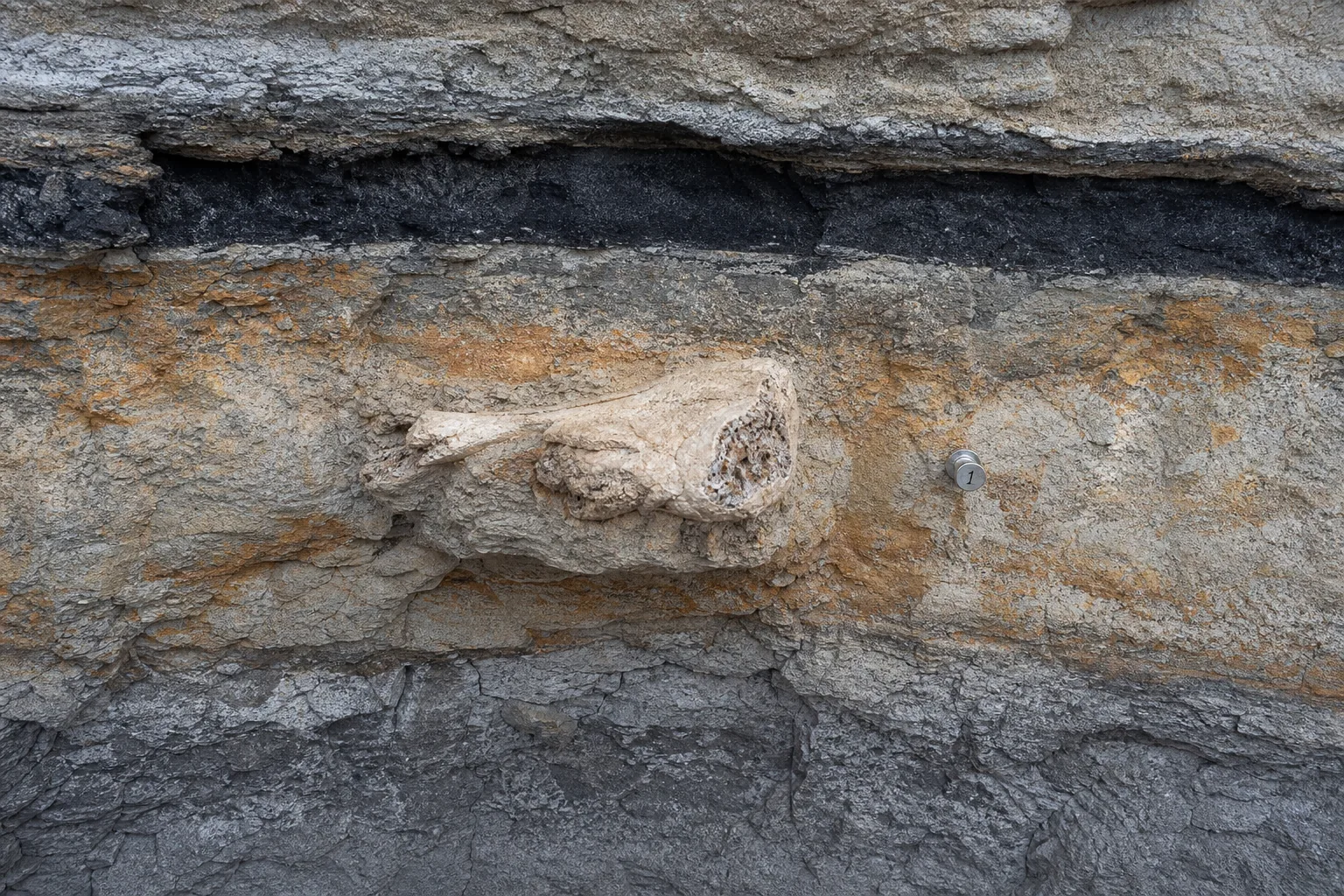
A bone comes out of a slope with mineral grains pressed into its broken end and a field label tied to it.
It is not an animal.
At most it is a remnant of one. Altered after death, buried under particular conditions, exposed again by erosion, noticed by a collector, and separated from the ground that gave it meaning.
Before it can say anything about life, it records the route by which it survived the destruction of life.
The Frenchman Formation near Eastend in southwestern Saskatchewan makes that easy to forget. The name suggests a single body of rock, a local time, and a fauna waiting to be counted.
The provincial map does not even separate it from its neighbours. Eastend, Whitemud, Battle and Frenchman appear as one undifferentiated Maastrichtian package.
A fossil occurrence does not arrive as a direct observation of an ancient ecosystem. It arrives as an object with a position, a record of treatment, an interpretation of its rock, and a long chain of opportunities for the original evidence to disappear.
Paleontology begins after the losses.
The object is not the organism
The first discipline is almost administrative. Collection guidance ties one catalogue number to one specimen where the associated information is unique. It connects a physical object to a label, a photograph, a scan, a preparation note, a determination, a loan and a publication.
It does not certify the species name.
It makes the claim inspectable.
The associated field record does other work. Country, administrative area, coordinates, coordinate datum, elevation or depth, collector, date, formation, bed and measured-section position identify where the specimen entered the record.
A field-style relation such as two metres below the purple layer is useful only when the marker, the direction and the section are documented. A later label saying only Eastend cannot reconstruct it.
These are not decorative fields around the real fossil. They are part of the evidence.
An impressive skull without a locality and horizon is not merely a poorly captioned museum object. It is an incompletely attributed data object.
The distinction sharpens when the specimen is not a body part. A trackway, footprint, burrow, trail, boring, coprolite, root trace, nest or egg records activity. Traces are rarely transported from their original substrate, which can make one unusually good evidence of a moment in that substrate.
It does not preserve the animal that made it.
The maker may be known.
The trace is still not the maker.
Nor does a body fossil preserve a body whole. Vertebrate remains commonly enter collections as isolated teeth, vertebrae, scales, limb bones or skull pieces. A single plant can enter the same record as leaves, stem, wood, roots, cones, seeds, pollen and spores.
One biological individual becomes many possible catalogue entries before anyone begins to count a fauna.
The record has already changed its unit of analysis.
Preservation makes abundance an inverse problem
Many fossils of one kind are taken to mean many living organisms of that kind.
It is sometimes true.
It is never the first inference.
Hard parts, resistant tissues, particular body sizes, suitable depositional settings and rapid burial pathways are overrepresented. Organisms with little preservation potential can be common in a living community and nearly absent from its recoverable record.
A robust shell can survive transport and burial that erase a softer organism beside it. An articulated association can preserve proximity without preserving living abundance.
The mechanism is not abstract.
In controlled decay experiments on brine shrimp, suppressing microbial activity changed the route to internal preservation. The experiment does not recreate every ancient bed. It demonstrates that preservation is responsive to process.
Taphonomy is the name for working through that process. Orientation, articulation, breakage, weathering, abrasion, bite marks, size distribution, sediment fabric and mineral alteration are observations before they become a story.
An aligned shell bed may record current action. A mixed-age bone bed may record reworking. An articulated specimen may need rapid local burial, protection from scavengers, or quiet stabilization.
Several histories can produce an object that looks much the same in a drawer.
The Pisco Formation supplies a check on intuition. Average net sedimentation there has been reported near 32 cm per thousand years. At that rate, ordinary background sediment would take thousands of years to cover a large carcass.
Exceptional preservation therefore calls for a more local burial mechanism. The average does not describe every point on a seafloor.
This is abduction, not the recovery of a witnessed event. The investigator tests which combination of processes can account for the surviving association, and states a conclusion no larger than the evidence permits.
Rapid local burial is required by this preservation state is a stronger scientific sentence than a precise unobserved death scene.
The fossil record does not merely have gaps.
It has filters.
Absence has several causes
Suppose a collector does not find a given kind of fossil in a Frenchman Formation exposure near Eastend. The conclusion that it was absent has already outrun the observation.
The organism may not have lived there. Its remains may not have been preserved. The relevant bed may have been eroded, covered, or not exposed. A collecting method may not recover the size or material in question. The locality may lie in an unresolved chronological interval.
One negative result can sit at the end of every one of those pathways.
The same restraint belongs in a collection database.
Coordinates carry uncertainty.
A vague locality name should not be converted silently into a precise pin. Exact coordinates may also be restricted, to protect an outcrop, landowner terms, or active research.
Public imprecision and physical absence are different facts.
This is why a specimen needs both geography and stratigraphy. Geography says where it was found. Stratigraphy says where it sits in an ordered record.
Neither can replace the other.
Neither restores a position that was never recorded.
The archive is selective before it is incomplete.
Appearances are observed boundaries
The phrase first occurrence sounds exact. It usually means the lowest or earliest collected occurrence in a stated section, record or analysis. Last occurrence carries the same limitation in the other direction.
Both are endpoints of observation, and then candidates for biological interpretation.
For extinction, the difference can be consequential. High-resolution uranium-lead work placed the Permian-Triassic boundary near 251.4 Ma and constrained the associated carbon-isotope excursion at Meishan to well under two hundred thousand years.
Those figures show why a stage-level bin can collapse a relatively brief environmental and biological interval into one apparent line.
They do not show that every lineage vanished at the same instant. A last collected occurrence may reflect extinction, range truncation, preservation failure, or the edge of a hiatus.
A causal claim requires more.
Temporal order, a plausible mechanism, geographic reach, and selectivity consistent with the proposed stressor.
Even magnitude changes with method.
A reassessment of terminal-Permian marine data estimated about 81% species loss rather than the familiar 90 to 96%. The event did not become unimportant. The denominator, the background extinction rate and the sampling structure became visible in the estimate.
The number is a result of a method. It is not engraved on a boundary.
The same logic protects abundance studies from a quieter error. A count of shells, teeth or tracks begins as a count of recoverable objects. It becomes a statement about a biological population only after the taphonomic window, collecting effort, taxonomic treatment and spatial and temporal support have been made explicit.
The specimen count is real.
Its biological meaning is inferred.
A minimum age needs two other arguments
A fossil can help date a lineage. It does not act as a clock by itself.
Three claims have to connect.
The specimen has a defensible geological age. It has a defensible phylogenetic placement. And that placement constrains the relevant node.
The consequence is conservative.
If a fossil belongs on a lineage leading to a crown clade, that lineage already existed at the age of the fossil-bearing horizon. Its true origin may be older.
A worked example makes the compression visible. A Palaeocene label spanning 55.8 to 65.5 Ma conceals nearly ten million years when it is treated as a point age.
Placement has its own preservation problem. Experimental decay work under controlled pressure shows how quickly diagnostic features are lost. A compressed or altered fossil can lack a feature because it decayed, was obscured by matrix, or lay outside the preserved region.
Missing data should be coded as unknown. It should not be converted into anatomical absence.
This matters because a tree is built from characters, not from resemblances alone. Taxa are scored for defined character states, including ambiguity and unknowns, then compared under stated criteria. Several independent characters and robust alternative placements are stronger evidence than one appealing similarity.
Published surveys have compiled well over a thousand fossil calibrations across the tetrapod literature. The scale of the practice does not make any single calibration automatic. It shows how often an evolutionary timescale depends on a chain from object to horizon to placement to model.
A fossil does not place itself on a tree. A tree does not date itself.
Independent clocks make a sequence answerable
The physical position of a fossil in a measured section comes before a numerical age. The section records contacts, beds, ash layers, polarity intervals and unconformities.
Superposition orders undisturbed beds.
Dated ash, where the dated event is relevant to deposition, supplies an anchor. Magnetostratigraphy and fossil turnover can test the framework from different directions.
The Denver Basin framework for the Cretaceous-Paleogene boundary analyzed zircon from a series of ash samples, including several from a continuous core. Its boundary age was an interpolated result, not a direct isotopic measurement of boundary clay.
That distinction carries the assumptions.
Correct correlation.
Continuity between anchors.
No hidden hiatus large enough to break the interpolation.
The framework placed the interval from non-avian dinosaur extinction to the appearance of the earliest Cenozoic mammals at roughly 185,000 years, with a stated upper limit. Those are basin-specific temporal results, not global recovery clocks.
Agreement among methods gives an age model force precisely because it can also fail. Reworked ash, contamination, structural duplication, an unrecognized channel scour or a wrong correlation can make fossil order, polarity order and numerical dates disagree.
The disagreement is not an embarrassment to be averaged away. It is evidence about the section.
Even astronomical tuning has a stated limit. Astronomical timescales beyond a certain age are treated as not robust unless independently tested with geochronology.
A sequence becomes more precise by adding independent constraints. Not by repeating a preferred interpretation.
The date is not a label attached to the fossil. It is a model of the rock around it.
What don’t we know?
The Frenchman Formation near Eastend is a useful Saskatchewan address for this problem precisely because a formation name does not answer the local questions.
The corpus does not establish a site-specific measured section, a local fossil inventory, a depositional setting, or the precise relation of any specimen to a dated horizon.
Those absences should stay visible.
For a locally missing fossil, the unknown is not merely whether the animal lived there. It is whether the relevant interval was deposited, preserved, retained through erosion, exposed, searched with an adequate method, identified correctly, and placed in a resolvable chronology.
Each answer alters the next inference.
There may be evidence elsewhere.
There may be none.
The negative observation cannot decide between those worlds alone.
This is not an argument that fossils tell us nothing. Fossils record anatomical combinations unavailable among living taxa. They can constrain minimum ages, reveal behavioural traces, test correlations, and make extinction tempo measurable.
They are extraordinarily information-rich objects.
They are not transparent ones.
A fossil occurrence records preservation before it records life. The specimen is evidence of an organism, of a depositional setting, and of a chain of losses between them.
The task is not to pretend the chain is absent.
It is to work out which links still survive.