There is a moment after the guards have withdrawn and before the all-clear when a quarry face is no longer an excavation.
Not as a turn of phrase.
A drilled bench has been charged to turn intact rock into a muck pile. The detonation also sends motion through the ground and pressure through the air.
The rock has not reached the crusher.
The event has already crossed the face.
At the Corman Park quarry district near Saskatoon, that distinction is not local colour. It is the ordinary condition of quarrying anywhere a bench has neighbours, roads, buildings, workers beyond the exclusion zone, or a permit boundary.
The exact conditions for that district are not in the corpus and need primary verification.
The mechanism does not wait for the paperwork.
A quarry blast is an off-site event before the rock is crushed.
The familiar sequence is drill, blast, load, crush.
That is the material sequence.
It leaves out the part that decides whether the sequence can continue.
Bench geometry.
The drilled reality of the rock.
The vibration record.
The airblast response.
The dust plume.
The haul route.
The moving line between active ground and ground that has to be watched from outside it.
Everything after fragmentation is a boundary problem.
A bench decides where force may go
A bench begins with rock mass, not with a preferred machine or a preferred height.
Intact strength, weathering depth, joint sets, bedding, fault zones, groundwater, face orientation, expected blast damage and catch-bench capacity determine what can be made into a drilling and loading platform.
Height changes potential fall energy and attainable hole length. Width has to carry the drill, the loading unit, traffic separation and fallen rock.
The word bench makes the arrangement sound fixed.
It is not.
Face angle, berm width and inter-ramp angle are coupled, and the combined slope is not one face angle copied down a drawing. A taller bench can reduce interruptions while increasing the consequence of a local failure.
A flatter overall slope can increase waste movement.
The production geometry is already a disturbance geometry.
Published quarrying standards give bench-width formulas keyed to bench height, and separate limits for soft rock. Those are not Corman Park dimensions and not a transferable recipe.
They show the form of the decision.
A dimension means something only alongside the rock, the slope, and the work happening on it.
At a final wall the distinction sharpens.
Controlled-blasting guidance sets burden-to-spacing ratios and hole spacings in multiples of hole diameter, with wider spacing for hard rock and closer spacing for weak rock.
Those are not production-pattern dimensions for a fractured quarry face. They are evidence that final-wall control is a different problem from advancing a face that will be mined away.
Hole diameter carries the same conditionality.
Smaller holes allow closer control and multiply drilling and initiation connections. Larger holes serve a larger production volume and make narrow-bench and perimeter control harder.
Neither diameter contains its own answer.
Explosive type, water, decoupling, confinement and receptors stay in the design.
The bench is where those variables meet.
It is not merely where the drill sits.
A designed hole is not a loaded hole
The drill pattern starts as geometry.
It becomes evidence hole by hole.
Collar locations, depths and orientations are measured.
Water conditions and deviations are recorded.
The planned pattern is compared with new face mapping. A void, a seam, a wet hole, a collapsed hole or a misplaced collar can invalidate an assumption made at the desk.
This is why drill-and-blast design keeps returning to the rock mass after the pattern has been approved.
Stemming decides whether detonation gases work on the rock or escape at the collar.
Too little confinement favours venting and ejecta.
Too much can leave a poorly broken collar zone. Subdrill can break a hard toe, and can disturb rock below the intended floor.
The actual hole is part of the blast design.
The operational cycle has three stages.
Drilling establishes the real holes.
Charging and tie-in complete stemming, initiation sequence, explosives accounting, guards and the exclusion zone. Firing is followed by inspection, not by automatic release.
The all-clear waits while the pile and face are checked for misfires, flyrock, unstable conditions and oversize.
That delay is not an interruption between extraction steps. It is where the fragment-size decision meets the rest of the site.
A toe that will not dig, a boulder too large for the primary feed, or crest rock loosened beyond the planned line is information about the previous blast and an instruction for the next one.
The loader cannot correct a pattern that keeps making the wrong rock.
Fragmentation becomes electricity and wear
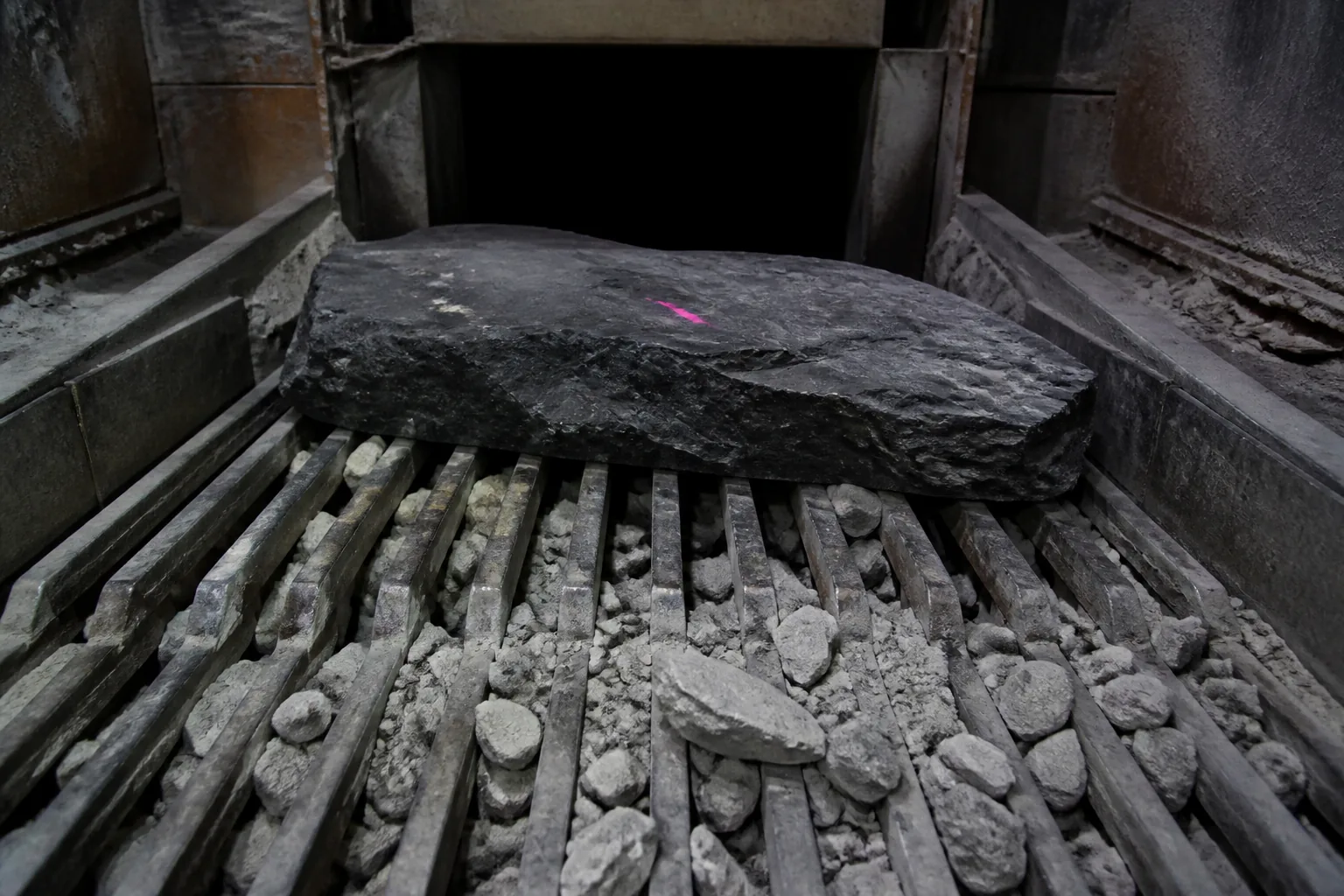
After release, run-of-quarry material moves through a dump hopper, feeder and grizzly to a fixed primary crusher, or directly into a mobile crusher, sometimes through a pre-screen.
Both routes require an oversize decision before the chamber. Reduce it safely at the face, or reject it before it enters. Regulator guidance on mobile jaw crushers identifies oversize, clay or other fines, foreign bodies, overfeeding and discharge accumulation as blockage sources.
This is the first cascade.
Fragment size affects loading.
Loading affects presentation to the hopper.
Presentation affects whether a scalper can bypass fines, whether a slab bridges the hopper, whether a crusher runs at a stable load, how fast liners wear, and whether the next screen sees material it can separate.
The number on a closed-side setting is not a finished aggregate product size.
The plant has its own spatial boundary.
Guarding rules turn on the distance between exposed moving parts and walking or working surfaces. Crusher layout includes people, access platforms and walkways, not only belts and chambers.
The sequence extends through time as well as space. Downstream conveyors and receiving equipment start before an upstream crusher and feeder. At shutdown, feed stops first, material is cleared as far downstream as practicable, and equipment shuts down in reverse.
A stopped destination cannot accept material.
A plant is a chain of open destinations, not a pile of machines.
Fragmentation reaches the electricity bill and the maintenance plan before it becomes a stockpile.
Then it reaches the road.
Ground and air are separate escapes
The total explosive mass in a blast is an inviting number, because it is large and easy to say. It is not the number that governs ground response.
Maximum instantaneous charge is the mass that fires at one delay interval. It works with receptor distance, ground transmission path, delay sequence, confinement and initiation reliability to shape vibration.
Two blasts with the same total explosive mass can therefore produce different records. One timing arrangement puts more mass into a single delay.
Another causes wave arrivals to overlap differently.
A change in geology alters the path before the charge is changed at all.
Air overpressure is related and separate.
Weather, face orientation, stemming and exposed detonating cord can change the air response without a matching change in ground vibration.
One monitor result cannot stand in for the other. A quiet ground record is not proof of a quiet air event.
A Welsh quarry condition uses 6 mm/s peak particle velocity for 95% of blasts, and 10 mm/s for a single blast, at vibration-sensitive buildings.
Those are neither Saskatchewan limits nor structural-damage thresholds.
Their value here is not their portability.
It is their refusal of a universal safe-charge number.
The usable record is a site regression built from instrumented blasts. Charge weight per delay, distance, measured peak particle velocity, weather, anomalous outcomes. Its conservative point has to reflect the upper spread of actual results, not only the favourable shots.
As a quarry approaches a receptor, or meets changed geology, the relationship has to be tested again.
The blast crosses the line.
Monitoring describes what crossed it.
Dust starts before the cloud
Dust control is described as water on a road, or a spray at a crusher.
That is the easy version.
Dust is made during drilling, at the hopper, the feeder, the crusher discharge and the transfer points, on roads and at stockpiles. Each location has a different plume, a different wind exposure, and a different chance to intercept particles before they disperse.
Crusher guidance gives an optimal spray-droplet range of 10 to 150 µm, and places nozzles upstream of dust-generation points. The number does not make a working system by itself.
Water quality, pressure, nozzle wear, spray angle, enclosure leakage and wind decide whether droplets meet the dust cloud or drift away from it.
An enclosure is a second system, not a decorative box around a conveyor. A filtered cab is specified by filter class and efficiency across a stated particle range. Open doors, damaged seals and cleaning that resuspends settled dust can defeat any filter rating.
The inspection record matters as much as the component specification.
The same boundary logic applies.
The quarry does not begin at the face and end at the stockpile. A visible plume, a changing wind and a monitored transfer point are part of the production system, because they determine whether the system can operate under its conditions.
The method chooses the disturbance
Quarrying is surface mining stripped to its most visible form.
In the broader open-pit sequence, clearing, topsoil segregation, drainage and a starter cut establish benches and haul routes.
Overburden and waste lead ore mining.
Mining leads crushing.
Crushing leads processing.
Dewatering, road relocation and wall monitoring continue while the face retreats or widens in a pushback.
The offset matters.
A mine can have a plant available and still lack accessible feed if stripping falls behind. It can also move waste too far ahead, tying capital to disturbed ground.
Technical reports separate tonnes moved from tonnes milled for exactly this reason. Waste belongs to the first number, and it shapes the disturbance sequence.
At quarry scale the same logic controls the next bench. The practical mining width exceeds the material contact, because benches, ramps and catch berms have to fit inside the surface geometry.
Grade-control spacing has to fit blast movement and the excavated increment. If digging blocks exceed contact uncertainty, material is misdirected. If they are much smaller than blast movement, the apparent selectivity is an illusion.
The method is not a choice made after geology ends. It is the geometry that turns geology into a schedule, a haul route, a crusher feed, a monitored boundary, and eventually a reclaimed area.
For Saskatchewan Crown quarry rights, the Quarrying Regulations of 1957 state that a quarrying lease may not exceed 640 acres, and that its length may not exceed twice its breadth.
Exploratory operations are to begin within 60 days of permit commencement unless another time is approved.
Neither condition supplies Corman Park’s local approvals, blast limits, hours, routes or monitoring locations. The province’s environmental-assessment process also notes that further provincial, federal and local approvals may follow an assessment decision.
That is the distinction the quarry cannot avoid.
A disposition describes one right.
A blast design has to survive every boundary it reaches.
What don’t we know?
The unknown is not whether vibration and airblast travel beyond the face.
They do.
Nor is it whether fragmentation changes the work imposed on loading and crushing.
It does.
What cannot be derived from a generic quarry range is the response of a particular event.
Local geology changes wave transmission.
Charge timing changes how energy arrives.
Weather changes air overpressure.
Receptor distance changes what the monitor records.
A face turning toward a final wall changes the purpose of the blast itself.
Every one of those variables is a local measurement, and none of them travels.
Corman Park conditions, approved blast windows, the local receptor inventory, allowable limits, haul routes and monitoring locations are not in this corpus.
They need the operative permit and primary measurements.
The Welsh vibration condition, the controlled-blasting geometry references, the spray guidance and the Saskatchewan Crown-lease rules are useful only while they stay attached to their sources and jurisdictions.
The rock will still break.
The question is what else happens when it does.