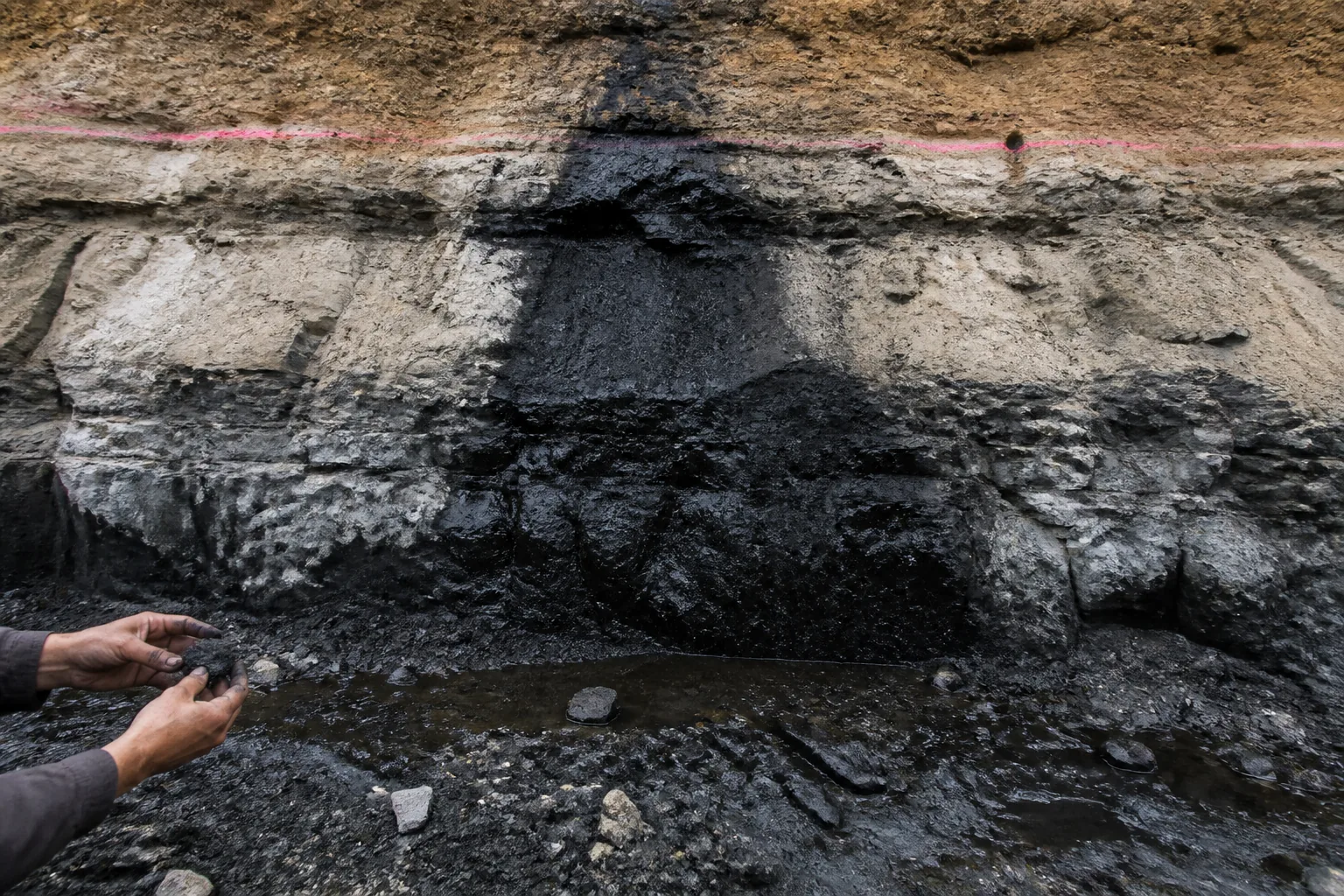
At the end of a potash process, the material can be dry enough to pass through handling equipment without becoming something else.
Not approximately.
Not as a loose assurance that a mine has found potassium.
Nutrien’s white granular muriate of potash data sheet states 0.2 wt.% moisture and a minimum 62.0 wt.% K2O, alongside chloride, sodium chloride and bulk-density figures.
Those values belong to a shipment.
They do not belong to a salt bed.
At the Esterhazy K3 operation in southeastern Saskatchewan, that distinction is the beginning of a much larger calculation. The current product mix, contracts and prices need primary verification.
The physical point does not depend on them.
A resource becomes commercially consequential only after a customer can recognize, handle and price the material that leaves the system.
A price is assumed to tell a mine what its resource is worth.
It does not.
It tells the mine what a specified product might be worth.
At a specified place.
During a specified window.
Under specified commercial conditions.
Everything between the salt and that definition has to be paid for.
Whatever cannot cross the definition stops being revenue-bearing material.
The number reaches backward.
A price begins where the product ends
Potash is a useful place to see the error, because one word spans several states of matter and several measures.
Muriate of potash is a commercial fertilizer product.
The USGS describes it as an agriculturally acceptable mixture containing 95% KCl or greater.
That is a different object from an ore rock, a mill feed or a reported grade.
An exploration grade is reported in potassium-oxide equivalent.
A mill feed has already acquired dilution, sampling history and stockpile effects.
A finished shipment has a nutrient guarantee.
It also has moisture, chloride, particle size, bulk density and perhaps anti-caking treatment.
None of them is a substitute for another.
A shipment certificate answers a question that a drillhole cannot.
The same logic appears in metals.
LME Copper defines a 25-tonne warrant.
Grade A cathode, an approved brand, a named chemical standard, a small tolerance.
A concentrate seller can use that price as a reference.
A concentrate is not thereby deliverable cathode.
Its settlement still carries metal payabilities, treatment and refining charges, impurities, moisture and final settlement rules.
A commodity name is not a product boundary.
The boundary is the product.
A benchmark is contract-shaped
Every serious commodity number has an address.
A unit, a quantity, a currency, a delivery basis, a time window, and a rule for which market evidence counts.
Without those fields the number is not a price observation.
It is a rumour about one.
The iron-ore assessment published as IODEX makes the structure unusually visible. It is a daily physical assessment for 61% Fe fines.
Delivered CFR Qingdao.
In US dollars per dry metric tonne.
With stated alumina, silica and phosphorus in the base specification.
Bids, offers, expressions of interest and confirmed trades count only up to a stated afternoon cut-off in Singapore.
The quality terms and the clock are part of the observation.
They are not background prose.
Change the moisture basis and a dry tonne is not a wet tonne. Change the delivery point and freight becomes a different part of the value. Change the product quality and a premium or a discount may be required. Change the averaging period and buyer and seller can experience the same market differently.
A formula contract therefore has to retain the base index, the averaging period, the spread, allowances, freight, charges and provisional-payment rules.
Lithium gives the same lesson in a different chemical form. A battery-grade carbonate assessment can define a minimum parcel size, a delivery window, and a payment instrument, alongside a particular quality and regional basis. A quotation for a narrowly qualified delivered battery chemical cannot answer what a mine’s concentrate, an ex-works technical-grade salt, or a different destination is worth.
A benchmark is not the market made simple.
It is the market made legible by excluding most of it.
The contract reaches back through the plant
Once a buyer’s boundary exists, the process route has a target. A potash operation does not merely recover potassium-bearing material. It has to make a product that meets a nutrient, physical-form and moisture condition at the agreed commercial boundary.
That changes what the plant is optimizing.
Mined tonnes and head grade still matter.
So do recovery, compaction yield, particle-size cut, drying, and the handling of the sodium chloride that leaves with everything else.
A stronger benchmark price can reward more recovery effort, more cleaning, a different size cut, or more reliable moisture control. A weaker one can make the same increment of recovery uneconomic.
The plant does not receive a price signal as an abstraction.
It receives it as a specification that has to be manufactured.
And the specification is unforgiving in a way a grade is not. A shipment that misses its moisture condition is not a slightly lower grade. It can be a rejected cargo, a demurrage claim, a caked silo, or a customer that buys elsewhere next season.
A higher price makes a larger resource
The salt is physically present before the price changes. What changes is the set of costs it can support.
This is where the word resource becomes dangerous.
It makes a technical inventory sound like a fixed commercial fact.
In practice a project compares the expected value of a defined product against mining, processing, transport, sustaining and closure costs.
Recovery falls.
Freight rises.
A customer demands a more exacting product form.
Material moves below the economic boundary and the salt has not changed at all.
The reverse is also true.
A higher expected product value can support a different cut-off, an additional recovery circuit, a different mining block, more development, or a larger capacity case.
It does not turn halite into sylvite.
It changes the range of technical choices for which the expected return is still adequate.
Fiscal terms reach the same boundary by another route. British Columbia’s mineral tax applies a 2% charge on net current proceeds while an operation has unrecovered capital, then a 13% net-revenue tax once the cumulative expenditure account clears.
Those rates are not a Saskatchewan potash rule and not a current-project model.
They make the mechanism visible.
A payment arriving before full capital recovery removes margin from material already exposed to price or cost decline.
The consequence is not a verdict on royalties.
It is a reminder that a mine’s cut-off is not set by geology alone. It is set where geology meets a product definition, a cost structure, a fiscal base and a required return.
A cost curve ranks without approving
Cost curves seem to offer an escape from this uncertainty. Arrange producers from low to high cost and the industry acquires a simple order. Safe mines on one side, exposed mines on the other.
The order is useful.
It is not complete.
An all-in sustaining cost curve is published on a schedule, in a currency, per unit of a chosen product.
That frequency is itself a warning.
A curve is a dated comparison.
It is built from one denominator, one reporting period, one currency treatment, one by-product convention and one set of operations.
If diesel, labour or exchange rates change across an industry, every bar can move while a mine stays in the same percentile. If a plant recovery improvement lowers one operation’s cost, it can move relative to its peers without changing the underlying deposit.
A sustaining metric also does not calculate the price at which a new mine should be built. It does not necessarily include the same replacement, financing, ramp-up or closure conditions.
In the short run a mine may keep running while revenue covers cash costs, contractual obligations or the cost of restarting. It need not recover its historic investment to do so.
Inventories can meet demand while price sits below the all-in cost of new capacity.
In the long run, persistent failure to cover sustaining and replacement requirements reduces future supply.
The two boundaries do not run through the same place.
The marginal cost is not a price floor.
It is one pressure in a system that takes years to answer.
Capital has to survive the next price
That delay is why a benchmark can rearrange a resource before anyone mines it.
The relevant price in a capacity decision is not the quotation visible on the day a board meets.
It is a range.
Assumed prices, product qualities, freight outcomes, construction costs, recoveries and demand conditions, extending through a build-out and an operating life.
The World Bank places medium-term commodity cycles at roughly 8 to 20 years.
That is not a calendar for predicting peaks.
It describes a structural problem.
Existing production benefits from a demand surprise immediately.
Drilling, approvals, financing and construction deliver new capacity years later.
When that capacity arrives, fixed plant, debt service, employment obligations and sunk capital make contraction slow.
The disciplined response is neither expansion at every high quotation nor permanent refusal to build. It is a normalized-price case, a downside case, staged commitments, an explicit sustaining provision and a closure provision.
A long-life, low-cost deposit can be defensible in a high-price period if it stays viable below the current level. A short-life, high-cost case whose value exists only at the benchmark of the moment is a different proposition.
This is not timidity.
It is an attempt to keep a temporary market observation from becoming a permanent industrial mistake.
The market reaches public balance sheets as well.
National wealth accounting combines natural, produced and human capital with net foreign assets.
Its question is not whether extraction produces cash this year. It is whether the depletion of a natural asset is being converted into something durable.
That question begins with the product boundary too.
No public revenue, private return, freight bill, processing investment or closure obligation exists in its assumed form until material crosses from geological occurrence into a defined saleable product.
The number does not price the ground
At Esterhazy the salt predates any published price assessment.
The potassium chloride in a finished shipment is the result of mineralogy, recovery, material handling, energy, equipment, measurement and product control.
Its nutrient guarantee belongs at the end of that chain.
But the chain runs backward.
The customer boundary determines what the plant has to produce. The plant boundary determines which feed, recovery and reliability assumptions matter. Those assumptions determine which blocks can bear the cost of access, processing, transport, sustaining work and closure. The anticipated margin determines whether capital waits, proceeds in stages, or is committed at full scale.
No benchmark discovers a tonne of ore.
It decides which tonne can carry the system required to turn it into a product.
Define a product.
Publish a price.
The bed was already there.
The boundary was not.